Bliss! Since 2004's A Very Long Engagement (which I found to be a fantastic, beautifully layered and stylized romantic mystery in the vein of Carlos Ruiz Zafón's novels), French filmmaker Jean-Pierre Jeunet (best known for Amélie) has been on something of a hiatus - but no more! I've been hearing a fair bit about Micmacs à tire-larigot, his upcoming war comedy, for some time now, but the first actual glimpses of the film have been released onto the web. And not only are we getting a short teaser - we're getting eight! Each one is dedicated to a specific character and provides a tantalizing glimpse of what looks like yet another unique delight from Monsieur Jeunet. Many are already drawing comparisons between Delicatessen and Amélie - which seem warranted and, given the high quality of those two films, certainly worth hoping for!
The teasers can all be found over at Twitch. Here's hoping this one gets a North American release date sooner than later! Now if you'll excuse me, I need to go rewatch all of the Jeunet films in my possession - erm, maybe with the exception of Alien: Ressurection.
July 1st marks the birth of our country here in Canada, and we're celebrating with a well-deserved holiday! For this day, I thought I'd get into the spirit by sharing some Canadian cinema-related material.
Now, any Canadian film fan who's worth their salt will know that one of the most celebrated Canadian films ever made is Claude Jutra's Mon Oncle Antoine (1971), which is about a Quebec boy's coming of age experiences in his asbestos mining town during Christmas. I recently re-watched Claude Jutra: An Unfinished Story, a fascinating documentary about the filmmaker included on the film's Criterion DVD that explores his childhood, early love for cinema (which he pursued to the point of bluffing his way with a bunch of friends into a hotel room for an impromptu interview with Federico Fellini and Giulieta Masina), steady rise in his career, later troubles with finding support for his projects (forcing him to go to English Canada to find work) and his struggle with Alzheimer's disease that led to his suicide in 1986. It's especially admirable for the way it provides a ton of information about its subject while also containing a great deal of emotional resonance.
It's too bad that more of Jutra's films aren't available on Region 1 DVD, but at least we have Mon Oncle Antoine, which is surely a Canadian classic. Attached below is the trailer for the film as well as A Chairy Tale, a stop-motion short co-directed by Jutra and Canadian animation wizard Norman McLaren and starring Jutra himself.
On top of that, here's Neighbours (1952), one of McLaren's most famous shorts:
Last winter, the other writers for the Toronto J-Film Pow-Wow and I were very excited when the Criterion Collection's Eclipse line announced it would be releasing four films from filmmaker Hiroshi Shimizu. They hit the streets this past March, but I didn't pick up my set until May...and it's a good thing I waited until then to do so.
The four films that come in the box set (appropriately titled Travels with Hiroshi Shimizu) seem ideally appropriate for the relaxing summer season, what with their mostly light, lyrical tone and cross-country exploration of Japanese culture that are so evocative of vacation excursions (sometimes directly so). Two of the films - The Masseurs and a Woman (1938) and Ornamental Hairpin (1941) - are even set at resorts, following the intersecting paths of its visitors and the relationships that form between them before they are inevitably broken off (providing achingly bittersweet moments in both films).
According to the DVDs' liner notes (written by Michael Koresky), Shimizu usually preferred to work with notes and outlines instead of strictly following a script. This method and its benefits can easily be seen in his films, as they largely consist of separate episodes and multiple storylines that are definitely more driven by character than plot. The earliest film in the set is the silent Japanese Girls at the Harbor (1933), which follows a fairly melodramatic storyline centered around two best friends and the man they both love. In my opinion, it is the weakest of the four films because of this soap opera-like story, even though it provides a solid frame around which Shimizu deploys a number of creative poetic flourishes (including dissolves, several of his trademark tracking shots and striking editing techniques).
My personal favorite of the bunch is 1936's Mr. Thank You. In contrast to Japanese Girls, its story of a kind bus driver and his passengers flows along effortlessly, showing how ideally suited Shimizu's casual approach is to the road movie structure. The film is one of the earliest examples of the road movie as we know it today and, in my books, one of the most effective. As the driver (and title character, known for his shouts of gratitude to the pedestrians who move aside for his bus) takes his passengers to Tokyo, their personalities, quirks and backstories are gradually revealed in a friendly and comfortable manner while the journey brings them into contact with a variety of people who occupy different areas of the social ladder. Simply, the film invites you along for the ride as one of Mr. Thank You's patrons, and Shimizu does his part to ensure the trip is an enjoyable one.
All of the films in this set feel to some degree like refreshing escapes that you can indulge in whenever you wish. And the best part - all of them are short and sweet, the longest only clocking in at 76 minutes. So, for those curious about this newly-released set, Shimizu-san himself or the golden age of Japanese film, take my word for it: now's the best time in the year to check out some of these recovered treasures.
As some of you might have noticed over the past few months, I've been somewhat/extremely lax regarding the number of posts I do for this blog. While, yes, overall laxness had a part in this recent famine, I must also honestly say that certain other responsibilities that I regularly tend to contributed as well, basically leaving my poor blog to get lost in the shuffle.
So, I've decided to change to overall aims and style of Subtitle Literate. From now on, it won't be focused on rounded-out reviews only, partly because I already do plenty of those regularly for the wonderful Toronto J-Film Pow-Wow. Instead, this site will become lighter, more casual, and more...well, blog-like. My attention will still mainly be dedicated to world cinema, but my contributions here will be more along the lines of thoughts, remarks, observations and shared links/material. I'll still put in a full film review every now and then, but definitely not with every post.
So that's pretty much how the big change-of-course will go, and from this point on, I'll be sure to get a whole lot more postings out there more often.
With that said, let me move on to my first post-revision topic: the Japanese filmmaker Nagisa Oshima.
About a week ago, after having read so much about this legendary iconoclast and his work, I picked up what is possibly his most famous film: 1976's In the Realm of the Senses. Mainly known for its highly explicit (and unsimulated) sexuality, I still wasn't quite sure what to expect.
Ultimately, I was quite pleasantly surprised. The film was much richer than I originally expected, seeing as how its premise, surrounding an overpowering sexual obsession shared between a man and woman in 1930s Japan, is fairly simplistic. Also, refreshingly, it confirmed Oshima's reputation as a talented and highly intelligent artist, and made me extremely curious to see more of his films.
As a result, I'm kicking myself for not having taken advantage of the great Oshima retrospective the Cinematheque Ontario held last fall, especially considering how few of his films are available in North America. Still, there's the newly released Criterion DVD of Empire of Passion (considered to be a companion piece for In the Realm) for me to seek out, and I can still continue to learn more about Oshima and hope that, before too long, more of his films will find exposure to Western audiences.
Attached below are the trailers for 1969's Boy and his final film (which he made after suffering a stroke), 1999's Gohatto (and yes, that is Takeshi Kitano in the latter trailer; he got his first dramatic part in Oshima's Merry Christmas Mr. Lawrence starring David Bowie).
Ladies and gents, there is a new film festival in Toronto.
My good friend Chris MaGee, founder of the Toronto J-Film Pow-Wow (to which I contribute on a regular basis), has just announced the Shinsedai Cinema Festival, which will run from August 21st-23rd. Co-programmed with Jasper Sharp of Midnight Eye, the festival will feature a slew of new films from Japan (many of which making their Canadian premieres here) screened at the Japanese Canadian Culture Centre in their brand new Kobayashi Hall, which can seat 450.
Those curious about the lineup can check it out here. It looks like quite a diverse bunch of fascinating new films to check out, and the fest is a great way to catch a first peek at the upcoming wave of talent fresh from Japan's shores (shinsedai translates as "new generation").
The news that Broken Embraces, the latest film from Spanish auteur Almodóvar, was selected to compete for the Palme d'Or in this year's Cannes Film Festival inspired me to revisit Volver, his previous film. Seeing it again reminded me of the filmmaker's great talent for weaving together stories made especially for women. They have remained an extremely significant motif throughout his career, and Volver is a stellar example of how admirably he uses them.
Penélope Cruz gives an excellent performance as Raimunda, a strong-willed woman who lives with Paula (Yohana Cobo), her teenage daughter, and Paco (Antonio de la Torre), her good-for-nothing husband. She also keeps in close touch with Sole (Lola Dueñas), her sister, and Agustina (Blanca Portillo), a friend of the family. In the first act, Raimunda must contend with two deaths: her Aunt Paula's, and, after he attempts to sexually assault his daughter, Paco's after he is stabbed with a kitchen knife. Additionally, she and her sister begin hearing and noticing strange things that suggest that the ghost of their mother, who is believed to have died in a fire, is lingering around them. Along with these events, Raimunda takes over a friend's restaurant and helps feed a visiting film crew, enlisting the help of her neighbors while managing both business affairs and the escalating developments surrounding Sole, Agustina, events of the past and the mysterious presence of her mother.
Volver is quite interesting partly because of the way it overturns certain expectations that some viewers may have going into it. Specifically, there are quite a few elements presented that would be right at home in a murder thriller or a ghost story - being namely Paco's body, which is temporarily hidden in the restaurant's freezer under many peoples' noses, and the appearance of Irene, Raimunda and Sole's mother (played by veteran Almodóvar actress Carmen Maura), who is at first suspected of being a restless spirit. However, these various things, though at first intriguing, eventually turn out to be red herrings, as the real theme of the film becomes and steadily remains focused on the bonds of family.
Then again, it should be no surprise that Volver doesn't dissolve into a simplistic genre flick since it thoroughly and undeniably remains an Almodóvar film throughout its entirety, meaning that it has a specific look and feel to it that is simply part of his signature as a filmmaker. Indeed, there is little doubt that Almodóvar is one of the most successful auteurs working in world cinema today, and Volver further continues the practice of his unique style. Thanks to the cinematography of José Luis Alcaine, the film is bright and lush, making marvelous use of primary colors - especially red. Consequently, the atmosphere remains consistently good-spirited, and even though some of the events are dramatic and even tragic at times, Volver never plunges to the gloomy level of, say, a Lars von Trier film (at the beginning of the film, Raimunda is seen working a number of lower-end jobs to make ends meet, but have no fear: Dancer in the Dark this ain't). Overall, one comes away from the film with an uplifting sensation, due to both the rewarding course of the narrative and the simple pleasure of seeing, both in front of the camera and behind it, work well done.
Overall, it was quite satisfying to see Volver again, and if anything, it will serve as a reminder for me to seek out more of Almodóvar's work in the future - and to root for him and Broken Embraces at Cannes this May!
Director: Florian Henckel von Dannersmarck
Country: Germany
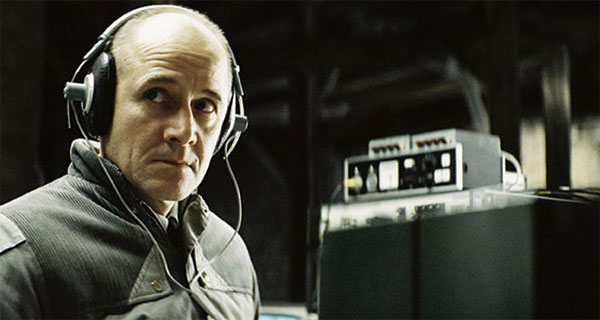
Like many, I was mildly surprised when the Oscar for 2006's Best Foreign Language Film went not to Guillermo del Toro's spellbinding masterpiece Pan's Labyrinth, but instead to this German-made thriller. However, after having finally seen it, the so-called upset is not so hard to believe after all. Combining historical significance with ample doses of suspense and character development, The Lives of Others is irrefutably one finely made film.
The story begins, quite appropriately, in 1984 within the socialist regime of East Berlin. A celebrated playright, Georg Dreyman, is chosen as the target of a surveillance operation by the much-feared Ministry of State Security (Stasi for short). Weisler, a diligent Stasi agent, carries it out, bugging the apartment where Dreyman lives with his longtime girlfriend Christa-Maria and listening in on their lives in the attic above them. However, when he discovers that the mission is meant to aid a despicable minister's goals, Weisler begins to have second thoughts and eventually develops feelings of genuine admiration for the couple. Matters are further complicated when Dreyman becomes more involved in suspicious activities while under the false impression that he is safe from the Stasi.
The Lives of Others is a genuine pleasure to watch for both its design and execution. The storyline is tautly crafted, providing a perpetual air of tension surrounding the people living under the malevolent, Big Brother-like gaze of the Stasi. Suspense is created not only through the main storyline surrounding Dreyman and whether he will be caught, but also a number of other subplots that act as seperately burning fuses, hinting at potential disaster at any moment. Matching the film's superb structure are its fascinating characters, all impressively acted. Sebastian Koch is suitably excellent as Dreyman, the artist struggling to maintain both his safety and a clean conscience, and Martina Gedeck does a fine job portraying the complex Christa-Maria. Ulrich Tukur makes a strong impression as a friend and superior to Weisler (especially in the tense scene that takes place in the cafeteria), but if there is any one actor to admire the most in the film, it would have to be Ulrich Mühe as Weisler himself. Ultimately, the film is telling his story, being that of someone who is at first a cold-hearted bloodhound for the Stasi, then experiences an awakening of sorts, gradually realizing the harm and consequences of his actions and doing his best to make compensation. Sadly, Mühe passed away from cancer in July of 2007, but The Lives of Others stands as a tribute to his remarkable talent - particularly in the film's eerily fitting final freeze-framed shot.
Recreating life in a fascinating yet terrible era of Germany's history, The Lives of Others is informative while never faltering in its devotion to narrative and character. Quite simply, it is a great story told in exactly the right way, hooking its audience and keeping them riveted on every twist and turn that unfolds before them. Without a doubt, I highly, highly, highly reccomend this one.
First of all, sorry to all for not posting a little more often than I probably should. I've actually been quite occupied recently, particularly in exploring the ether of Japanese cinema on a number of fronts (including my other blogging commitment, the Toronto J-Film Pow-Wow). In any case, I'll try to make up for it and up the dosage of reviews over the next little while.
Now we get to one of my favorite films by one of my favorite directors: François Truffaut's Day For Night. Wonderfully showcasing Truffaut's trademark humanism, it follows a film crew as they face the day-to-day challenges of making a movie. Over the course of their shooting schedule, their various crises include a veteran actress who can't remember her lines (Valentina Cortese, who worked with Federico Fellini in Juliet of the Spirits, a fact that her character alludes to), various love affairs among the cast and crew, secretive actors and one reluctant kitten. Filling out the impressive cast are the stunning Jacqueline Bisset, Alexandra Stewart, Jean-Pierre Aumont, Truffaut stalwart Jean-Pierre Léaud and, most interestingly, Truffaut himself as none other than Ferrand, the director.
As is usually the case with Truffaut, Day For Night is filled with a variety of great little elements and sketches, patching together an entertaining and truth-infused imitation of life. Even as he reveals the tricks of the moviemaking trade, he keeps the people who live by it at the forefront of the film, bringing them to life as colorfully drawn individuals. In reference to a quote from Truffaut's longtime comrade and friend Jean-Luc Godard, just as the cinema isn't the station, but the train, the main concern of this movie isn't whether the film will be made, but instead how the film crew will make it - their journey as opposed to their destination. And what a journey it is, riddled with its share of crises and even grim moments, but nonetheless a joyful and satisfying one.
I revisited this film after finally giving Synecdoche, New York its much-deserved second viewing, and it's interesting how the two both compare and contrast. While both are about the process of making art (specifically, autobiographical art), Charlie Kaufman's wonderfully unique and mind-boggling film dwells in the agony and, it seems, futility of capturing an accurate representation of life in art, while in Truffaut's film, everyone just gets on with it, living their lives as they throw themselves into their work, all in a film that, as is usually the case, is chock-a-block full of details from Truffaut's own life and previous films. Like the camera which at one point turns to regard the audience (no doubt a nod to a similar moment in Godard's Contempt), Truffaut in turn flips his camera around onto himself to examine the craft that he has devoted his life to, making a funny and light-hearted salute to the cinema and the people who literally populate it (all while avoiding becoming bogged down in figuring out the various aspects and relationships of his life, unlike Philip Seymour Hoffman's character in Synecdoche). In a way, it stands as a key to better appreciating his own work. While it has never been as radical or daring or even as interesting (at least on a formal level) as that of Godard or Agnès Varda, that was never really the point. Instead, the point is the work itself; the film that weaves together an artificial world in front of your eyes. Most films are like magic tricks that are judged by their impressiveness or spectacular qualities; Truffaut's magic simply lies in the illusion itself that he and many others have, against all odds, managed to pull off time and time again - all for your viewing pleasure.
To cap off this review, I have two relevant add-ons. One is another picture I took of a film shoot I encountered in Paris during my trip to Europe last year which seems to embody the cinema of Truffaut - particularly in its depiction of three reoccurring elements in his work: cinema, children and the Eiffel Tower, which he often prominently featured. Note great little details like the various crew members captured in mid-action and the passing bus, both of which bringing to mind Day For Night's classic opening street sequence.
The other is this marvelous American Express commercial which was made by and stars Wes Anderson (featuring his buddies and regular actors Jason Schwartzman and Waris Ahluwalia). This is a neat homage to Day For Night, complete with the music that was actually used in the film ("Grande Chorale" by Georges Delerue) and the names François and Jean-Pierre - a great treat for Anderson and Truffaut fans alike!
I discovered this great hidden gem after finally picking up the Eclipse set which features two works from the great, overlooked Soviet director Larisa Shepitko, whose life was tragically cut short by a car accident in 1979. Even though she left behind a legacy of only four feature films, the talent that she demonstrates in both Wings and the stunning The Ascent is enough to qualify her as one of the greatest female directors in world cinema.
Wings is a fascinating character study which features the renowned actress Maya Bulgakova as school headmistress Nadezhda Petrukhina. Living an at-times painfully mundane life in the confines of classrooms and hallways, she often recalls her former position as a courageous fighter pilot during World War II. As she daydreams of soaring amongst the clouds, you begin to share her desire for more exciting pursuits. As a buttoned-down official, she faces her share of challenges, most notably a delinquent student who constantly defies authority and faces expulsion from the school, but they are mere trifles compared to the all-too-sweet promise of exhilarating freedom that repeatedly haunts her throughout the film. There is even the strong possibility that she sees something of herself, or who she used to be, in the rebellious youth, which keeps her from dismissing his case entirely. Ultimately, her inner conflict invites a serious consideration of age, destiny and belonging, her case that of a passion having grown painfully out of reach.
Wings had a somewhat unexpected, delightful effect on me. Even though it is unquestionably a film bearing the unique vision of its maker, it also reminded me of several other European films that helped make up the worldwide boom in arthouse cinema during the 1960s, namely Federico Fellini's 8 1/2, Ingmar Bergman's Persona, Chris Marker's La Jetée and Agnès Varda's Cléo From 5 to 7. There was just something about the poetic, semi-documentarian way in which Shepitko shot her scenes and actors, capturing the natural hubub of everyday life, combined with the bold, innovative confidence in her style that reminded me of the great advances narrative film was making during that legendary time (this video, featuring Martin Scorsese, someone who I could listen to talk about film all day, discussing Michelangelo Antonioni's L'Eclisse, has also been bouncing around in my brain recently; maybe it had something to do with the association). As a result, I've been revisiting a number of such films since (including 8 1/2, one of my all-time favorites), reminding me of how fruitful this period truly was for the cinematic medium. As a recent second viewing rewardingly confirmed for me, Wings is definitely a film made in the same spirit of creativity, certifying Shepitko's place alongside other Soviet New Wavers such as Andrei Tarkovsky (Andrei Rublev) and Mikhail Kalatozov (The Cranes Are Flying).
This is one film I'll definitely revisit often and cherish in my collection. Inspiring on multiple levels, Wings follows a woman's journey of self-discovery with great style, throwing in sights and sounds of everyday life and tasteful artistic flourishes. Both it and Shepitko easily warrant attention.
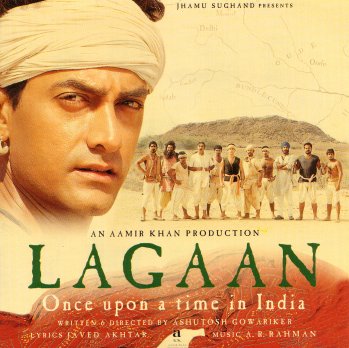
It's only fitting that I follow up Slumdog Millionaire with a genuine Bollywood flick. This particular one was made fairly recently and gained much acclaim, most notably an Oscar nomination for Best Foreign Film and worldwide popularity. I chose to seek it out in the middle of a gloomy Canadian winter with hopes of raising my snow-bound spirits, and boy, did it do the trick. True to the ambitions of many a Bollywood picture, Lagaan is hugely entertaining on multiple levels.
The film is set in 1893, when the British still had a colonial presence in India. Its title refers to a grain tax that villages must pay towards the English. In the midst of a draught, a small village's prospects grow considerably darker after the arrogant Captain Andrew Russell (a villain perfectly designed to draw all manners of boos and hisses from the audience) doubles the Lagaan for seemingly no other reason than sheer malice towards the native population. Enter Bhuvan, a spirited young man (played by star Aamir Khan, who also produced the film) who takes up a challenge against the sneering officer for his people's good: a cricket match which, if won by the village, will excuse the entire province from Lagaan for three years; but if the British win, the Lagaan will be tripled.
I was delighted to notice that this film bears many similarities with another Asian epic: Seven Samurai. As in that film, a village facing a threat from forces of oppression must gather together a team of heroes in a short period of time to prepare, practice and mount a defensive force. Granted, Lagaan is set in India, centers around a cricket match rather than actual combat and throws in all sorts of extra ingredients like colonial politics and enthralling musical numbers, but nonetheless, the resemblances are there. As in Kurosawa's film, the story's structure allows plenty of time to be devoted to the numerous characters both within and outside the village as each side prepares themselves and the cricket match looms closer and closer. Plenty of subplots crop up, most prominent among them a love triangle between Bhuvan, Gauri (Gracy Singh), a village girl who harbors strong feelings for him, and Elizabeth (Rachel Shelley), the Captain's sister who decides to help the Indian team.
Lagaan could accurately be described as more focused and straight-forward than most other Bollywood epics. By sticking to the villagers' plight and their opposition to the colonial forces' tyranny, it maintains a fairly consistent tone and doesn't go overboard with too many outlandish elements. That said, it still contains its share of song and dance sequences, which I greatly enjoyed. The music was provided by none other than A.R. Rahman, who also composed the score for Slumdog Millionaire and is nominated for three Oscars for his work on that film (for Best Original Score and the songs "Jai Ho" and "O Saya"). Each song provided a nice break from the narrative flow while amplifying the characters' emotions at various points with hugely entertaining vivacity (though maybe it wasn't such a good idea to have Elizabeth join in for one song with her own, comparatively bland Western musical style).
Even though it clocks in at 3 hours and 45 minutes, Lagaan moves its story along at a steady pace, and not one minute of it felt wasted. This is probably as good a "crossover" flick into the vast realm of Bollywood cinema as you're likely to find, giving a good taste of authentic Indian screen entertainment in a highly accessible form. It certainly worked for me, and I'm looking forward to seeking out more of the delights that Bollywood has to offer. For those of you out there who are looking for something to tide you over until Slumdog comes out on DVD (or, at least, sweeps the Oscars, which I'm hoping it does), why not give this a try?
We've come a long way from The River. Based on the novel by Rumer Godden, that film is a French-American co-production directed by Jean Renoir and set in India. It balances the coming of age story of a young girl in an English household by the banks of the Bengal river with documentary-like segments depicting the life and customs of the Indian people. Being Renoir's first color film, it is beautiful to look at and tries to provide an embracing, honest look at India, but it is still very much situated in a distinctly colonial perspective. As Satyajit Ray, who served as an assistant on the film and went on to become one of India's most renowned filmmakers, noted with disappointment, though the film was about and shot in India, only one of the principal players was Indian (played by the actress Radha). Honest and revealing though it may be, it only ever achieves a partial view of India. But like I said, we've come a long way from The River, and since that film, Western filmmakers have progressed considerably in their consideration of this magical country.
Recently, there has been a sort of resurgence of interest from Western filmmakers to make movies in and about India. Last year, we saw Wes Anderson's The Darjeeling Limited, which still carried his trademark style, but was nonetheless set in India (drawing influence not only from The River, but also the films of Ray himself). Shortly before the Mumbai attacks, Paul Schrader openly voiced his desire to go to India to make a film there. And then comes Slumdog Millionaire: the Danny Boyle-helmed Dickensian romance centered around a gameshow which just happened to take film festivals by storm, clean up at the Golden Globes and has a very strong chance of doing the same at this year's Academy Awards ceremony.
Tons have already been written about Slumdog in the interwebs and beyond, so I'll keep my own assessment of the movie short. Frankly, I loved it. The kinetic, stylish, madcap Danny Boyle who gave us Trainspotting is back, but in a whole new setting that oddly suits him. While his recognizable traits are present, he also makes the wise (and, as far as what I've heard about India, irresistable) choice to surrender to his surroundings. Unlike The River, or The Darjeeling Limited for that matter, he successfully captures the real, unfiltered India in his film, drinking in the many intoxicating sights and not shying away from the harsher ones, letting them all be captured by his cameras (which, according to this interview with Darren Aronofsky, sound like a guerilla filmmaker's wet dream) and contribute immeasurably to the story he is telling. In this film, India is very much an active participant in the story, helping shape the characters, growing and changing right along with them. Slumdog uses an old, tried-and-true story formula of a long, challenging quest for lost love, but its success is all about the way that story is told, and the captivating adrenaline rush that this film delivers is full proof of that. I can't wait to see it again.
Oh yeah, and this is my favorite to win Best Picture at the Oscars this year (even though it would be very cool if the Academy bestwed the award to a certain superhero flick).
As promised, here is my final message to you before we head into 2009. This past year marked the start of this little blog of mine, and I'm glad to see that quite a few people from all over the world have tuned in to it (according to the nifty little world map in the right-hand column, anyways). This has been a very cool way for me to share my enthusiasm of world cinema with like-minded film buffs out there, and I hope everyone has enjoyed my reviews and gotten a few ideas for new films to discover.
Now, as for New Year's resolutions, I hope to plow ahead in more new (to me, at least) areas of world cinema. Here's a tally to see which countries have gotten some representation so far:
As you can see, I've pretty much only "covered" Western Europe and the Americas so far. While I'm merely going with the flow and following what tickles my interest at any given time, I would genuinely like to venture into other national cinemas such as those of Africa, Asia, Australia and South America (although I also regularly contribute to the Toronto J-Film Pow-Wow, which focuses exclusively on Japanese cinema). Off the top of my head, I can see myself pursuing the well-received Tsotsi and reviewing it for the site before too long, with plenty of other films from those mentioned areas to follow.
So that's my resolution for this site, and I hope to follow through with it and make many new cinematic discoveries throughout the upcoming year. I wish everyone out there a very happy and healthy New Year's and 2009!
While the holiday season is perhaps the most appropriate time to revisit Ingmar Bergman's masterpiece, any time of the year is a good one to see this enchanting piece of cinema - especially given its cyclical structure. And really, why wouldn't you make an excuse to see this embracing, beautifully-made work by one of the true masters of cinema?
At first, one may be daunted by the size of this film, be it the three-hour film version or the five-hour cut that originally aired on Swedish television (which is the one I've continually chosen to watch since I first saw it, and which this review specifically focuses on). On top of the running time, it is a rich, sprawling work that covers many subjects and themes - which is fitting, since it was much publicized as Bergman's last foray into filmmaking (although he made a small number of television projects since then and emerged from retirement one last time to make Saraband in 2003). It is certainly a fitting swan song to a body of work that has explored numerous aspects of humanity and mortality; life, death, identity, love, family, disease, time, art, memory and so much more have all appeared before Bergman's camera at one point or another, and Fanny and Alexander certainly serves as a summative reconsideration of such themes.
However, despite its size and scope, this film never feels overlong, pretentious or contrived. It is a very simple tale that unfolds at just the right place and never exceeds its status as such. Yes, it's a five-hour film, but it's exactly the length it needs to be in order for the story to unfold in the way it does. And truly, Fanny and Alexander is one of the great marvels of cinematic storytelling in terms of economy, style and substance. Bergman's material is extremely well-written, but what's even better is how he presents it, which is in such a way that you want to keep following his characters and see how they fare in the situations that arise in their lives. Essentially, the film is of the hallowed tradition of stories that plunge you into their worlds, where you want to keep exploring and living long after they have ended.
Fanny and Alexander are two young siblings living in turn-of-the-century Sweden with their prodigious bourgeois family, the Ekdahls. At the head of the clan is the matriarchal Helena, followed by her three sons: the boisterous, joyful old scoundrel Gustav Adolf, the moody, debt-laden Carl and the quiet, good-natured Oscar, director of the local theater and father to the two titular children. The entire first part of the film is dedicated to exposition as most of the film's main characters are introduced during the famous Ekdahl Christmas celebration. In it, we meet the children, the three brothers, their wives and Helena, but time is also given to smaller characters like the various servants of the household and the members of the theater company. During this long party sequence, there are so many fascinating dynamics between these characters as they interact with each other, creating several micro-narratives that play out within the Christmas sequence. The relationship between the servants and the higher-class family members alone is fascinating to observe as some of the older maids reveal the hidden bitterness that has come with several years of serving the Ekdahls. Scene by scene, we learn the habits and personality of each character, gradually coming to know what to expect from each of them for the rest of the night (and the film, for that matter). I would definitely call this one of the better depictions of Christmas in film simply for the multitude of emotions that arise - not only the positive, joyous ones (which are played up to death in nearly every Christmas movie, TV special and song out there), but also the more negative, pent-up ones that simmer all year (or, in the case of some characters, all their lives) before they are finally uncorked during the big family get-together. This kind of honesty is rare in holiday films, and rarer still in North American ones.
After Christmas, though, the main narrative thread really gets rolling, seeing Fanny and Alexander through a number of harrowing adventures after unfortunate circumstances force them to live under the oppressive rule of Bishop Vergerus, one of the most memorable villains to ever grace the screen. I don't want to reveal too much else about the film's plot, as part of what makes the film so enjoyable comes from seeing many of the characters who were so lovingly developed in the Christmas sequence face new and unexpected challenges throughout the rest of the film both as individuals and as the family unit that ties them together.
As I said before, Fanny and Alexander is essentially a good yarn; a fairy tale told in a beautifully rich yet extraordinarily simple way. There are wonderous elements to it such as magic and ghosts, but they are just as much fun as the various characters and settings that make up Bergman's world (special kudos go out to the Oscar winning costume designer Marik Vos, art director Anna Asp and set decorator Susanne Lingheim for helping create that world). Legendary cinematographer Sven Nykvist captures lush colors and shadowy realms in images that indulge the eyeballs and fire the imagination. There are funny little inconsistencies and odd, unexplainable moments that occassionally turn up, but you can't help but accept them as they happen, simply because a) the characters accept them (so why shouldn't you?), and b) you're already so immersed in the story that you just want to shut up the logical part of your brain and keep watching.
Fanny and Alexander is one of my all-time favorite films (as of this moment, it's certainly in my top 10), an opinion shared by my cousin Yves (who says it just might be his number one favorite) and countless others. Utterly enchanting, fantastically well made and packed with moving moments and strong emotion, it is one of the most rewarding film experiences you could hope to discover.
Plus, as a "happy holidays" sort of thing, here is a list of five of my favorite Christmas movies (or, to be more precise, arty movies that happen to take place around Christmas).
1) Fanny and Alexander (Ingmar Bergman, Sweden) - see above!
2) Mon Oncle Antoine (Claude Jutra, Canada) - Often touted as one of the greatest Canadian films ever made, this is kind-of the Great White North's equivalent to Fanny and Alexander - often dark, centered on a young boy's coming of age in an uncertain world and equally concerned with the forces of life, death and sex.
3) Eyes Wide Shut (Stanley Kubrick, United States of America) - Another fairy tale, this time set in a New York that never existed, as realized by another of cinema's great orchestrators. See if you can spot a Christmas tree in every setting! 4) C.R.A.Z.Y. (Jean-MarcVallée, Canada) - Come back to Canada with this stylish story of sexual discovery and sibling rivalry in Quebec through the 1960s, '70s and '80s. The film with the best soundtrack on this list.
5) Brazil (Terry Gilliam, United Kingdom) - A little holiday cheer with terrorists, bombs, government incompetence, plumbing, conspiracy, more government incompetence and a giant computer chip-laden samurai thrown in for good measure.
Well, this has been a great start for this little blog of mine, and I thank all readers around the world for tuning in. Until my last little blurb before the new year, I wish everyone a happy holiday season wherever you are. Cheers!
With all of the recent hubub over Stephenie Meyer, her teen- and tween-based Twilight book series and the recently released Twilight movie, it's safe to say that vampires are "in" again. However, because of the Mormon author's drastic makeover of classic vampire lore (No fangs? Crosses don't work? Neither does sunlight? Or holy water? Or garlic?!), it's a strange time to be a fan of classic, Gothic vampire fiction - you know, the real stuff. Nosferatu, Bram Stoker, Carl Th. Dreyer's Vampyr - mention any of those crucial cultural keystones of vampire culture to a Twi-hard (as some of the Meyer fanatics like to call themselves), and you'd probably get a look as if broccoli had just sprouted out of your ears before she starts gushing about Edward Cullen all over again.
Fortunately, there's an alternative to this depressing picture: Canada's own Guy Maddin has a solid antidote ready with Dracula: Pages From a Virgin's Diary, a film that offers much comfort and contentment in the original way it re-tells Stoker's highly influential vampire story. Based on a Royal Winnipeg Ballet production by Mark Godden, the film unfolds in the silent film style of the 1920s and '30s that Maddin uses so often combined with choreographed dance sequences. It's a brave venture, but a well-executed and ultimately memorable one.
Right away, one can't help but be drawn into Maddin's scatterbrained imagination as it gives the classic Dracula tale a unique makeover. This is pretty evident in the film's opening, which focuses not on Jonathan Harker, as the book and most film adaptations do, but instead Lucy, best friend to Harker's fiancée, Mina. Even before she encounters the Count, she has to contend with three proud and slightly bufoonish suitors and her mother, who is encased in a glass coffin, incessantly rings a bell for her daughter and is connected to a huge, whirring ventilator. As closely as it follows the original story, this Dracula is filled with the kinds of phobias and quirks that Maddin continually returns to in his films, including a sense of terror and naive curiosity surrounding sex.
The splendid music and accompanying dance sequences add a new dimension of non-verbal storytelling for Maddin to play with and are quite enjoyable. It's true that one doesn't think of ballet right away when the words "Dracula" or "vampire" are mentioned, but here, it oddly suits the material quite well and gives a refreshing spin on the familiar story (not to mention that, considering the equally Gothic Phantom of the Opera and its legendary success on Broadway, perhaps it isn't such an unlikely match after all). The Gustav Mahler score is far more satisfying than the flat, tinny soundtracks usually put together for silent film DVD releases, and the ballet sequences beautifully illustrate such scenes as the suitors' courtship of Lucy, her nightmare in which winged gargoyles dance around her bed, Dracula's seduction of both her and Mina and Van Helsing's climactic quest to find and kill the vampire.
As part of his style, Maddin combines the exaggerated conventions of silent cinema with his own over-the-top sense of humor with great comedic results. When Dr. Van Helsing prescribes protection against the visiting vampyr, Lucy's maids and suitors surround her room and sleeping body with mounds of garlic. At one point, the insane asylum-bound Renfield (servant of Dracula and eater of bugs) chomps on a guard's arm and draws a mouthful of glistening black blood, eyes rolling madly as he does so. The quaint dialogue of silent cinema is amusingly reproduced in such chuckle-worthy lines as "The blood of a brave man is the best thing for a woman in trouble," and the essence of silent-era melodrama is reproduced in spades through the actors' bulging eyes and diverse array of facial expressions.
Maddin's Dracula is essentially a silent film itself, as it contains no audible dialogue, but it could never be mistaken for a film from Murnau or Dreyer. Like the works of those directors, Dracula mainly uses well-framed black-and-white photography mixed with some color filters, but unlike them, Maddin indulges in various other effects available to him, including Super 8 photography, sparsely-used sound effects and colored highlights within the monochrome images. In a way, this allows Maddin to have his cake and eat it too, giving him a means of continuing his love affair with silent film while making good use of more recent techniques.
As with most, if not all, of Maddin's films, Dracula: Pages From a Virgin's Diary is not for everyone. However, for fans of vampire fiction who are tired of the same old, uninspired re-hashings of the Dracula myth, this great little flick might be just the ticket you were looking for.
Subtitle Literate offers film reviews, notes, original photography, interesting links and miscellaneous bits of news from Marc Saint-Cyr, writer, cinema enthusiast, and creative spirit.
Marc Saint-Cyr studied cinema and history at the University of Toronto. His writing has appeared in publications as varied as the Directory of World Cinema: France, volumes 1-3 of the Directory of World Cinema: Japan, CineAction, Midnight Eye, Row Three, Senses of Cinema, Toronto Film Scene, the Toronto J-Film Pow-Wow, and the VCinema Podcast and Blog. He lives in Toronto with his girlfriend Adrie Marie and their cat Poobaby.
Film Books Where You Will Find Some Of My Writing:
I contributed an essay on the French New Wave and a few film reviews to this book on French cinema. Edited by Charlie Michael and Tim Palmer, it will be out in March 2013.
The second book of essays and reviews on Japanese film, edited by John Berra, is in stores now.
This book, edited by J-Film Pow-Wow founder Chris MaGee, looks at Tokyo's legacy on film and includes essays and pieces on specific areas of the city that have appeared onscreen.
A volume of film reviews and essays on Japanese cinema, edited by John Berra.






 Posts
Posts


