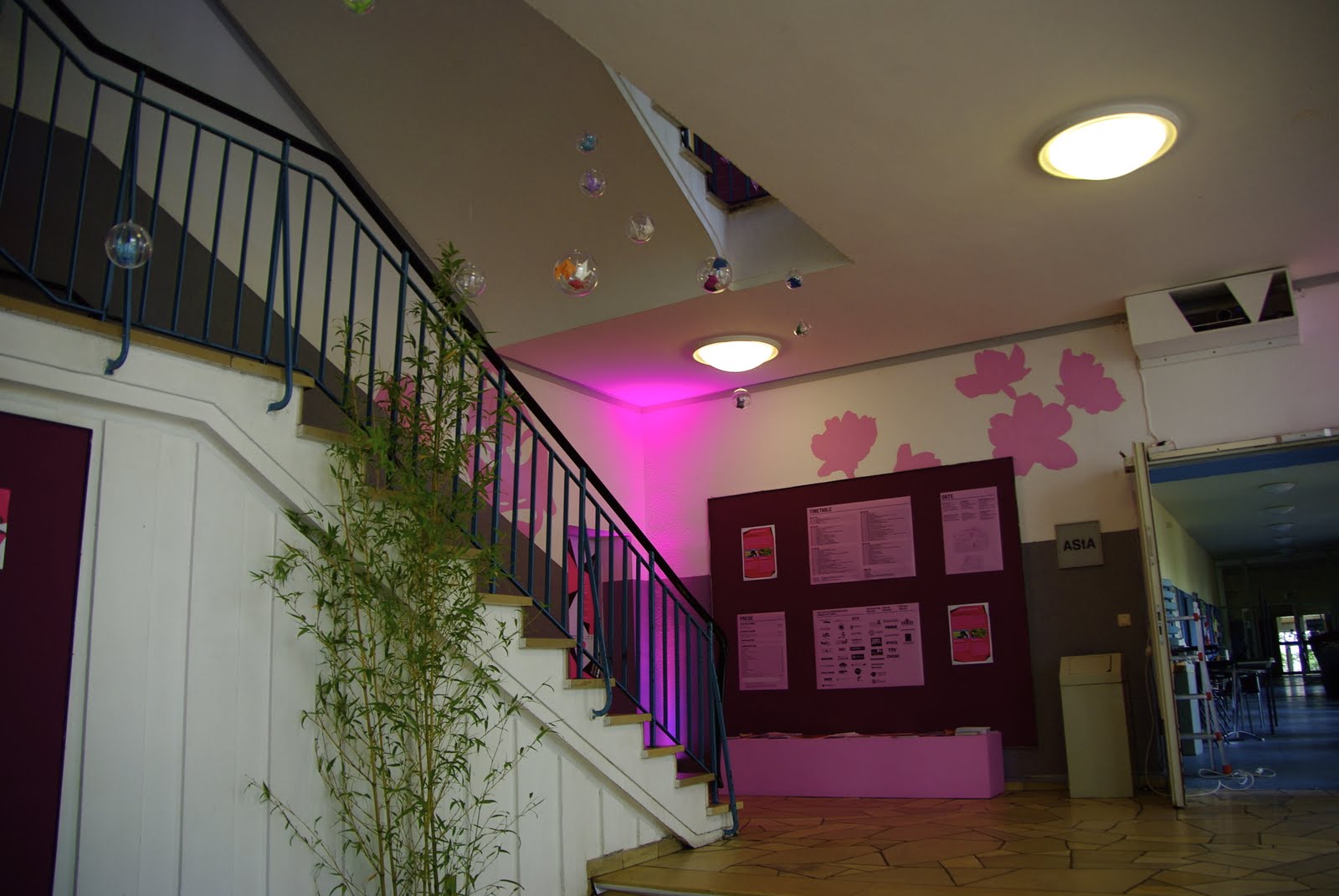
You can also scroll below to check out some of the pictures I snapped throughout that week:
Monday, May 16, 2011
Frankfurt: Spring 2011
A few weeks ago, I returned from my second trip to Frankfurt for this year's Nippon Connection film festival, which ran from April 27th to May 5th. With great weather, wonderful people and interesting films, I certainly had an awesome time. To read the coverage that my buddy Chris MaGee and I wrote up on the fest and specific films, head over to the Toronto J-Film Pow-Wow.
Labels:
Frankfurt,
Japanese cinema,
Nippon Connection
Saturday, April 16, 2011
My Recent VCinema Guest Spots - Review of Park Chan-Wook's "Thirst"; Podcast Discussion of Edward Yang's "Yi Yi"
Hello all! I know I'm a little on the late side with a few of these items, but better late than never, as they say!
Anywho, not too long ago I made a few contributions to the VCinema Podcast and Blog, the earliest of which being a review written for the Korean Cinema Blogathon 2011. The online event, organized by newkoreancinema.com and cineAWESOME!, was quite the success, as it resulted in 150 pieces from 50 web sites, each one focusing in some way on Korean cinema. You can check out the complete archive of pieces right here, and read my VCinema review of Park Chan-Wook's vampire flick Thirst (2009) here. Next year, when the Blogathon swings around once more, I hope to a) have seen a lot more Korean films and b) submit more pieces.
Shortly after that, I returned to VCinema, this time as a guest on their podcast for a discussion of New Taiwan Cinema; the late, great filmmaker Edward Yang and his masterpiece Yi Yi (2000). This will be one of three episodes in which I and the VCinema boys talk about certain films from the "big three" of contemporary Taiwanese cinema, consisting of Yang, Tsai Ming-Liang and Hou Hsiao-Hsien. You can access the Yang episode by clicking on the image below or looking it up on iTunes under "The VCinema Podcast."
Anywho, not too long ago I made a few contributions to the VCinema Podcast and Blog, the earliest of which being a review written for the Korean Cinema Blogathon 2011. The online event, organized by newkoreancinema.com and cineAWESOME!, was quite the success, as it resulted in 150 pieces from 50 web sites, each one focusing in some way on Korean cinema. You can check out the complete archive of pieces right here, and read my VCinema review of Park Chan-Wook's vampire flick Thirst (2009) here. Next year, when the Blogathon swings around once more, I hope to a) have seen a lot more Korean films and b) submit more pieces.
Shortly after that, I returned to VCinema, this time as a guest on their podcast for a discussion of New Taiwan Cinema; the late, great filmmaker Edward Yang and his masterpiece Yi Yi (2000). This will be one of three episodes in which I and the VCinema boys talk about certain films from the "big three" of contemporary Taiwanese cinema, consisting of Yang, Tsai Ming-Liang and Hou Hsiao-Hsien. You can access the Yang episode by clicking on the image below or looking it up on iTunes under "The VCinema Podcast."
And hey, what do you know! I took so long posting this episode up on here that the VCinema guys have already come out with their new one! In it, they embark on a discussion of the insane, wonderful, Indonesian actioner that is 1986's Rambu AKA The Intruder. Check out the episode by clicking on the image below.
Labels:
Edward Yang,
Korean Cinema Blogathon 2011,
Rambu,
VCinema Podcast,
Yi Yi
Saturday, March 26, 2011
Toronto Film Events: Japan Relief Screening of "Fine, Totally Fine" + The One Minute Film & Video Festival
Hello all. I'm chiming in here to bring your attention to two noteworthy events that, if you're into film and live in or near Toronto, will hopefully be of interest to you.
The first is an upcoming screening of Yosuke Fujita's 2008 film Fine, Totally Fine, which will be taking place on Tuesday, April 5th at 7pm at the Revue Cinema in Toronto. Organized by my friend Chris MaGee of the Toronto J-Film Pow-Wow in collaboration with Pictures Dept. and Third Window Films, this event is designed to raise money for the relief effort going on in the wake of the recent earthquake/tsunami disaster that has rocked Japan. Tickets are only $8, and 100% of the proceeds will be going to the SUPPORT JAPAN - GAMBARE/ JustGiving relief fund created by Yuko Shiomaki, president of Pictures Dept. and distributor of Fine, Totally Fine. To seal the deal, the film itself is supposed to be absolutely delightful and totally worth seeing - especially for a mere $8 that will be going to charity!
Here's the trailer:
The second event I'd like to bring your attention to is the One Minute Film & Video Festival, which is being directed by Matt Brown of the MAMO Podcast, which he co-hosts with Matt Price. The festival, which will be showing films exactly 60 seconds in length, will be held this year on March 31st at the Toronto Underground Cinema at 7pm, with ticket prices set at $10 at the door. Set around the specific theme of social/media, it sounds like the festival will have quite a bit to offer. From the press release:
"In addition to new works from filmmakers in Toronto and around Canada, the 2011 One Minute Film & Video Festival features new films from Japan, Italy, Australia, Germany, Poland, Romania, South Africa, and the United States, offering a complete, international film festival experience in a single screening.
Festival Director Matt Brown has also put together a programme of thirty personal favourites from the first five seasons of the One Minute Film & Video Festival. This retrospective will screen jointly with the new works presented in the social/media programme on March 31. A total of sixty one-minute films (thirty new, thirty old) will screen starting at 7 p.m. at the Toronto Underground Cinema."
The website for the event can be accessed here.
The first is an upcoming screening of Yosuke Fujita's 2008 film Fine, Totally Fine, which will be taking place on Tuesday, April 5th at 7pm at the Revue Cinema in Toronto. Organized by my friend Chris MaGee of the Toronto J-Film Pow-Wow in collaboration with Pictures Dept. and Third Window Films, this event is designed to raise money for the relief effort going on in the wake of the recent earthquake/tsunami disaster that has rocked Japan. Tickets are only $8, and 100% of the proceeds will be going to the SUPPORT JAPAN - GAMBARE/ JustGiving relief fund created by Yuko Shiomaki, president of Pictures Dept. and distributor of Fine, Totally Fine. To seal the deal, the film itself is supposed to be absolutely delightful and totally worth seeing - especially for a mere $8 that will be going to charity!
Here's the trailer:
The second event I'd like to bring your attention to is the One Minute Film & Video Festival, which is being directed by Matt Brown of the MAMO Podcast, which he co-hosts with Matt Price. The festival, which will be showing films exactly 60 seconds in length, will be held this year on March 31st at the Toronto Underground Cinema at 7pm, with ticket prices set at $10 at the door. Set around the specific theme of social/media, it sounds like the festival will have quite a bit to offer. From the press release:
"In addition to new works from filmmakers in Toronto and around Canada, the 2011 One Minute Film & Video Festival features new films from Japan, Italy, Australia, Germany, Poland, Romania, South Africa, and the United States, offering a complete, international film festival experience in a single screening.
Festival Director Matt Brown has also put together a programme of thirty personal favourites from the first five seasons of the One Minute Film & Video Festival. This retrospective will screen jointly with the new works presented in the social/media programme on March 31. A total of sixty one-minute films (thirty new, thirty old) will screen starting at 7 p.m. at the Toronto Underground Cinema."
The website for the event can be accessed here.
Saturday, March 12, 2011
Call for Aid to Japan in Wake of Earthquake and Tsunami Crisis
Hello all. As everyone who reads this is aware, on this past Friday, March 11th of 2011, Japan was stricken by one of the biggest earthquakes ever recorded not only in that country, but in the world. The 8.9 quake struck the North-East area of Japan near the Miyagi Prefecture and brought with it a devastating tsunami that swept over farms and towns and claimed hundreds of lives. As of this writing, the number of people still missing is around 9,500, while nearly 1,000 people are expected to be dead and over 1,400 injured. along with the simple factors of survival and recovery in the affected areas, the biggest issue remains the Fukushima nuclear plant's instability due to malfunctions in the reactor's coolant controls and backup generator. Efforts are still underway to restore radiation concentration to normal levels.
Myself and others involved in the Asian cultural community are deeply alarmed and saddened by this terrible disaster, and have been checking up on friends and family in Japan via e-mail and social media - efforts that have thus far mainly consisted of reports of safety and good health. However, there are still countless others who will require assistance in the days and weeks ahead. For those who wish to lend their support to this important cause, one of the best ways to do so is to donate to the Japan Society Relief Fund, which will be working in conjunction with other Japanese and American non-profit organizations providing aid to Japan. Rest assured that the Japan Society, based in New York, is highly respected for its support of Japanese cultural events (including the Japan Cuts film festival) in the past, and that 100% of what you donate will go towards the relief effort.
To make a donation, please click on the link below:
More information on the Japan Society can be found here, while a more detailed write-up on Japan's current condition in the wake of this disaster can be found at the Toronto J-Film Pow-Wow.
Any amount you can spare to this cause, towards any reliable organization, will be greatly appreciated by those who need it the most.
To make a donation, please click on the link below:
More information on the Japan Society can be found here, while a more detailed write-up on Japan's current condition in the wake of this disaster can be found at the Toronto J-Film Pow-Wow.
Any amount you can spare to this cause, towards any reliable organization, will be greatly appreciated by those who need it the most.
Monday, February 14, 2011
Xala (1975)
Director: Ousmane Sembène
Country: Senegal
Plot: Xala opens with a significant political event that foreshadows the rest of the film: in a moment of triumph and pride, Senegal's white, French rulers are booted out of office by native officials - only to be kept on as advisors*. This contradictory move gives way to the preparations being undertaken for businessman El Hadji's (Thierno Leye) wedding to his third wife. During his lavish reception, he seems content, but trouble arises when he fails to do just that on his wedding night - he is impotent, made so apparently from a xala - a curse. As El Hadji desperately searches for a cure, his reputation and business collapse around him, forcing him to come face-to-face with his own faults.
Thoughts: I truly appreciate a good piece of social satire. When done well, it can reveal fascinating insight into a country or culture's defining characteristics, deliver important critiques and calls for change and be extremely entertaining in the process. Xala fits all of those criteria marvelously. Ousmane Sembène, one of Africa's most beloved and respected filmmakers, adapted his own novel into this darkly funny film that takes dead aim on the African ruling class and their blatant fixation with European culture and lifestyle. All throughout the film, El Hadji and his upper-crust colleagues surround themselves with lingering symbols of whiteness - suits, imported goods ranging from foods to cars, the French language, which they proudly speak instead of Wolof, which is used by other characters (with pride, in some cases). Some African customs are adhered to - but only the ones that suit the men, like the taking-on of multiple wives. While El Hadji subscribes to that practice all too enthusiastically, he is less accommodating to one involving sitting on a mortar and holding a pestle between his legs that will aid his virility - perhaps having something to do with his later misfortunes? In any case, El Hadji is soon humbled by the xala as his wives and colleagues turn their backs on him, and gradually realizes that the solution to his problems won't come from any foreign good or ideal, but rather the customs and beliefs of his native culture.
Xala is populated by a considerable selection of supporting characters beyond El Hadji, each of their stories seeming to carry additional comments on the social conditions around them. In one great scene during El Hadji's wedding, his first two wives sit and talk openly about their feelings of disgust and jealousy surrounding their new, younger rival. Throughout the film, Sembène drops in on a group of impoverished beggars and cripples who wander from one place to another before executing a most delicious revenge on the upper class. One tragi-comic plotline involves a farmer whose money from his meager crops is stolen by a pickpocket. Too ashamed to return to his family and workers empty-handed, he takes refuge in the city while the thief reaps the benefits of his handiwork.
What is truly admirable about Sembène's craft is how he expresses his ideas with bite, cleverness and clarity. The central theme of culture clash is broadcasted perhaps most powerfully in a scene between El Hadji and his daughter in his office. The desk in the middle of the room is just one of the things that separates them: while he wears his suit and tie, she is clad in a bright African outfit of green, yellow, blue and purple - which happens to match a map of Africa on the wall behind her (which I'm sure was no accident). The wall behind El Hadji, on the other hand, is blank. She refuses his offer of water by saying she doesn't drink imported water, to which he proudly replies that he drinks at least two litres of it every day. It is made utterly clear that father and daughter are occupying completely different planes of thought, opinion and culture. She knows without any doubt who she is and where she comes from, whereas he is on shakier ground which crumbles away bit by bit as the film goes on.
Final Words: Xala is one of Sembène's better-known films, and I don't think it'd be going too far to call it a classic of not only his work, but African cinema in general. Those curious to see more films from this side of the world would do well to seek out this intelligent, entertaining statement on cultural allegiance and morality.
*Senegal became officially independent from France in 1960. Whether Xala is a period piece set during that time or not is unclear, though I'd personally guess that Sembène set the film in the (then-)present day and devised his own fictitious, alternate history of Senegal in which to stage his satire.
Country: Senegal
Plot: Xala opens with a significant political event that foreshadows the rest of the film: in a moment of triumph and pride, Senegal's white, French rulers are booted out of office by native officials - only to be kept on as advisors*. This contradictory move gives way to the preparations being undertaken for businessman El Hadji's (Thierno Leye) wedding to his third wife. During his lavish reception, he seems content, but trouble arises when he fails to do just that on his wedding night - he is impotent, made so apparently from a xala - a curse. As El Hadji desperately searches for a cure, his reputation and business collapse around him, forcing him to come face-to-face with his own faults.
Thoughts: I truly appreciate a good piece of social satire. When done well, it can reveal fascinating insight into a country or culture's defining characteristics, deliver important critiques and calls for change and be extremely entertaining in the process. Xala fits all of those criteria marvelously. Ousmane Sembène, one of Africa's most beloved and respected filmmakers, adapted his own novel into this darkly funny film that takes dead aim on the African ruling class and their blatant fixation with European culture and lifestyle. All throughout the film, El Hadji and his upper-crust colleagues surround themselves with lingering symbols of whiteness - suits, imported goods ranging from foods to cars, the French language, which they proudly speak instead of Wolof, which is used by other characters (with pride, in some cases). Some African customs are adhered to - but only the ones that suit the men, like the taking-on of multiple wives. While El Hadji subscribes to that practice all too enthusiastically, he is less accommodating to one involving sitting on a mortar and holding a pestle between his legs that will aid his virility - perhaps having something to do with his later misfortunes? In any case, El Hadji is soon humbled by the xala as his wives and colleagues turn their backs on him, and gradually realizes that the solution to his problems won't come from any foreign good or ideal, but rather the customs and beliefs of his native culture.
Xala is populated by a considerable selection of supporting characters beyond El Hadji, each of their stories seeming to carry additional comments on the social conditions around them. In one great scene during El Hadji's wedding, his first two wives sit and talk openly about their feelings of disgust and jealousy surrounding their new, younger rival. Throughout the film, Sembène drops in on a group of impoverished beggars and cripples who wander from one place to another before executing a most delicious revenge on the upper class. One tragi-comic plotline involves a farmer whose money from his meager crops is stolen by a pickpocket. Too ashamed to return to his family and workers empty-handed, he takes refuge in the city while the thief reaps the benefits of his handiwork.
What is truly admirable about Sembène's craft is how he expresses his ideas with bite, cleverness and clarity. The central theme of culture clash is broadcasted perhaps most powerfully in a scene between El Hadji and his daughter in his office. The desk in the middle of the room is just one of the things that separates them: while he wears his suit and tie, she is clad in a bright African outfit of green, yellow, blue and purple - which happens to match a map of Africa on the wall behind her (which I'm sure was no accident). The wall behind El Hadji, on the other hand, is blank. She refuses his offer of water by saying she doesn't drink imported water, to which he proudly replies that he drinks at least two litres of it every day. It is made utterly clear that father and daughter are occupying completely different planes of thought, opinion and culture. She knows without any doubt who she is and where she comes from, whereas he is on shakier ground which crumbles away bit by bit as the film goes on.
*Senegal became officially independent from France in 1960. Whether Xala is a period piece set during that time or not is unclear, though I'd personally guess that Sembène set the film in the (then-)present day and devised his own fictitious, alternate history of Senegal in which to stage his satire.
Labels:
African cinema,
colonialism,
Ousmane Sembène,
satire
Wednesday, February 2, 2011
The World (2004)
*Hello all. Just a few quick words before the film review, which will be the first one on this site to use a new format that will hopefully allow for briefer, more frequent posts. From now on, I'll be using three short sub-sections per review: Plot, Thoughts and Final Words. Their contents should be pretty self-explanatory, and this format will both make it easier for me to churn out my thoughts on the films I watch and give you more content that'll be easier to decipher than the older, lengthier reviews. Thanks for reading, and enjoy!
Director: Jia Zhangke
Country: China
Plot: Tao (Zhao Tao) is a young woman who lives in and works at the World Park in Beijing, which features such attractions as models of famous landmarks from around the globe and live shows put on by performers dressed in costumes from different cultures. Tao is in a relationship with Taisheng (Taisheng Chen), who followed her to Beijing and works in the park as a guard. They undergo a period of strain and doubt mainly caused by Taisheng's dissatisfaction with her. Other characters are focused upon throughout the film, including a new Russian employee named Anna (Alla Shcherbakova) and other workers, including "Little Sister," a childhood friend of Taisheng's.
Thoughts: The fourth feature film from Jia Zhangke and the first to be approved by the Chinese government, The World does quite well in delivering his easily apparent ideas about the ever-dominant trends of globalization. The park itself (a dream location for a director like Jia, and one that makes me wonder if he draws inspiration from Antonioni much like some of the New Taiwan Cinema's directors did) broadcasts quite clearly the sad, absurd commodification of history and culture with its models of the Pyramids, the Eiffel Tower, the Arc de Triomphe, the Pyramids and the Leaning Tower of Pisa (which, comically, people still pose with as if it were the real thing). By such a place as the World Park existing, actual countries and cultures are subjected to broad, stereotypical generalizations by being represented only by their best-known landmarks and fashion styles while travel itself is devalued (one of the slogans chirped by the park's recordings is "See the world without ever leaving Beijing!").
Besides themes and ideas, Jia also makes sure to flesh out the lives of his characters, many of whom work in different areas of the park by day and tend to chores in their dingy, dorm-like accommodations by night. The issue of money pops up numerous times throughout the film, perhaps most devastatingly in Anna's struggle to make a living in Beijing, the prospect of hostessing that is dangled before Tao at one point and the sad fate of "Little Sister" after an accident on one of his night shifts. Certain scenes stand out for their tragic quality and make The World an insightful and heartfelt cautionary tale of the pitfalls of industrial progress.
The World's story is peppered with several amusing animated segments that add small splashes of color and style to the film. Significantly, each segment springs from text messages, giving an almost mythic quality to the social media format that has only become more widespread since 2004. Lim Giong, who provided the music for Hou Hsiao-hsien's Millennium Mambo and a number of Jia Zhangke's other films (inlcuding Still Life, 24 City and I Wish I Knew), creates a score that fittingly alternates between upbeat and contemplative. One other notable stylistic feature is Jia's use of chapter headings at certain points, emphasizing specific passages and lending some structure to the film's events. Significantly, one chapter is entitled "Tokyo Story." That is no accident, as Jia also uses an excerpt from the famous Ozu film's soundtrack as the camera lingers on a crestfallen mother and father sitting together.
Final Words: The Ozu references may at first seem out-of-place for a film like The World, especially considering how little Jia focuses on the subject of family (as Ozu did throughout his career). Yet one can draw similarities between the two directors in how they each approach their respective themes with great degrees of patience, insight and compassion. Thus far throughout his career, Jia has kept his gaze firmly fixes on issues stemming from his country's race towards change and progress - and, judging from his international reputation, has reached a fair amount of success doing so. The World gives a pretty clear idea of what he is capable of as both a social critic and an artist, and presents his relevant ideas in a highly effective manner.
Director: Jia Zhangke
Country: China
Thoughts: The fourth feature film from Jia Zhangke and the first to be approved by the Chinese government, The World does quite well in delivering his easily apparent ideas about the ever-dominant trends of globalization. The park itself (a dream location for a director like Jia, and one that makes me wonder if he draws inspiration from Antonioni much like some of the New Taiwan Cinema's directors did) broadcasts quite clearly the sad, absurd commodification of history and culture with its models of the Pyramids, the Eiffel Tower, the Arc de Triomphe, the Pyramids and the Leaning Tower of Pisa (which, comically, people still pose with as if it were the real thing). By such a place as the World Park existing, actual countries and cultures are subjected to broad, stereotypical generalizations by being represented only by their best-known landmarks and fashion styles while travel itself is devalued (one of the slogans chirped by the park's recordings is "See the world without ever leaving Beijing!").
Besides themes and ideas, Jia also makes sure to flesh out the lives of his characters, many of whom work in different areas of the park by day and tend to chores in their dingy, dorm-like accommodations by night. The issue of money pops up numerous times throughout the film, perhaps most devastatingly in Anna's struggle to make a living in Beijing, the prospect of hostessing that is dangled before Tao at one point and the sad fate of "Little Sister" after an accident on one of his night shifts. Certain scenes stand out for their tragic quality and make The World an insightful and heartfelt cautionary tale of the pitfalls of industrial progress.
The World's story is peppered with several amusing animated segments that add small splashes of color and style to the film. Significantly, each segment springs from text messages, giving an almost mythic quality to the social media format that has only become more widespread since 2004. Lim Giong, who provided the music for Hou Hsiao-hsien's Millennium Mambo and a number of Jia Zhangke's other films (inlcuding Still Life, 24 City and I Wish I Knew), creates a score that fittingly alternates between upbeat and contemplative. One other notable stylistic feature is Jia's use of chapter headings at certain points, emphasizing specific passages and lending some structure to the film's events. Significantly, one chapter is entitled "Tokyo Story." That is no accident, as Jia also uses an excerpt from the famous Ozu film's soundtrack as the camera lingers on a crestfallen mother and father sitting together.
Final Words: The Ozu references may at first seem out-of-place for a film like The World, especially considering how little Jia focuses on the subject of family (as Ozu did throughout his career). Yet one can draw similarities between the two directors in how they each approach their respective themes with great degrees of patience, insight and compassion. Thus far throughout his career, Jia has kept his gaze firmly fixes on issues stemming from his country's race towards change and progress - and, judging from his international reputation, has reached a fair amount of success doing so. The World gives a pretty clear idea of what he is capable of as both a social critic and an artist, and presents his relevant ideas in a highly effective manner.
Wednesday, January 26, 2011
The Face of Another (1966)
Director: Hiroshi Teshigahara
Country: JapanI'm going to jump back into reviews for this site with a look at a particularly unique science fiction film from Japan: Hiroshi Teshigahara's The Face of Another. It is one of many innovated films that emerged from the Japanese New Wave movement, which lasted from the late 1950s to the early 1970s and consisted of such well-known directors as Nagisa Oshima, Seijun Suzuki, Shohei Imamura and Teshigahara. Anyone who's familiar with even a few of the works produced by these filmmakers will know that they represented a fresh, young, rebellious spirit that arose in the Japanese film industry. Stylistic innovation and the examination of topics like controversial social issues and the lower class were very much at the top of their priorities, and a look at Teshigahara's film (the first of his I've seen) reveals those same characteristics.
The Face of Another marks one of four instances in which Teshigahara collaborated with author Kobo Abe, who wrote screen adaptations of his own works - the other three films being Pitfall (1962), Woman in the Dunes (1964) and The Ruined Map (1968). Frequently compared to Franz Kafka, he specialized in writing strange, existentialist stories about alienated individuals. The Face of Another thus seems like an archetypal Abe narrative: a man (the incredible Tatsuya Nakadai, who continues to impress me with every fresh performance I see) is disfigured beyond recognition in an industrial accident at his workplace. His face clad in bandages, he essentially gives up his former, "whole" self as dead and cynically resigns himself to living the rest of his life as a different person - a monster. His doctor (Mikijiro Hira) offers him an unconventional solution: a realistic mask that will give him a brand new face. But soon after acquiring and wearing the mask, the man starts to become psychologically affected by the prospect of a completely new identity and tests the possibilities that come with it.
The Face of Another is an extremely fascinating film for many reasons. The dynamic between its characters is compelling to watch as each of the supporting players react to the man's shifting attitude towards his disfigurement in different ways. The film proceeds not as a conventional protagonist-vs.-antagonist storyline, but more as a series of philosophical conversations in which matters like identity, the importance of appearance and how society operates based on such superficial concepts. Nakadai gets the majority of the most interesting dialogue, often spoken in the many wonderful scenes shared with Hira's doctor, who has his own motives for helping his patient. He often discusses the appeal of hiding one's identity from the outside world, and essentially uses Nakadai as a guinea pig to test his own ideas. This creates a most unusual relationship that absolutely hooks the viewer and makes up a crucial component of the film.
If The Face of Another only focused on the man and his doctor, it would be great. But themes are also explored through two women: Nakadai's wife (Machiko Kyo), whose relationship with her husband changes significantly following the accident, and an unnamed girl (Miki Irie) whose own face is partially scarred from the infamous Nagasaki bombing. The latter, who never meets Nakadai, offers up an interesting counterpoint to the ideas of outward appearances and how people manage theirs in different ways.
Shot in gorgeous black-and-white, The Face of Another uses a slew of creative cinematic techniques including freeze-framing, back projection, dramatic lighting, unusual framing and more. The film's set design is also to be applauded - particularly the doctor's eerie workshop, in which his furniture and work area is placed on a blank white soundstage decorated with molds and models of different body parts. I especially liked the strange art piece shown in one scene that mainly consists of carved ears:
Weird but cool stuff - and not unlike the work of H.R. Giger. Also weird but cool is the unsettling score provided by Toru Takemitsu, one of the great Japanese score composers and another frequent Teshigahara collaborator. Between the echoing, metallic noises that underline the film's concentration on existential horror and the very different, sweeping waltz that is played over the opening credits and allotted several variations, Takemitsu offers the perfect sonic counterpart to the film's powerful imagery and storyline.
A very clever and sophisticated piece of work, The Face of Another now has me dying to check out more of Teshigahara's films. Along with his other Abe adaptations, I'd most like to see his 1984 non-fiction film Antonio Gaudí, which is most appealing for the convergence of three major artistic forces: Teshigahara, Takemitsu and, of course, the enigmatic Catalan architect Gaudí.
I leave you with Takemitsu's splendid waltz from the film:
Thursday, January 13, 2011
VCinema Goodness!
Hello all. Happy New Year! I am once more back in the GTA, refreshed and ready to get a start on 2011. This year will hopefully bring about a few more posts and reviews here as well as other projects and pursuits elsewhere.
Speaking of, there are a few interesting things going on over at the website for the VCinema Podcast and Blog, which specializes in news, reviews and podcast episodes on Asian cinema. Recently, they posted a series of three articles in which a variety of writers, scholars and all-around Asian cinema fans spoke up about their favorite Asian film experiences in 2010, revealing a broad variety of tastes and experiences. I was one of those contributors, as was my editor and compadre John Berra, who was a guest on Episode 13 of the podcast and regularly writes reviews for VCinema. You can check out our entries here; the other two articles in the series can be found here and here.
The VCinema podcast will soon be celebrating its first anniversary on January 31st, 2011. In order to celebrate the special event, they are currently holding a special contest that I'm sure will be worth taking part in - if your knowledge of Asian cinema is up to snuff. Here is editor and producer Coffin Jon's blurb on the contest:
Episode 22 of our podcast, scheduled for release on January 31st, 2011, will mark the VCinema podcast’s first anniversary. Can you believe it?! We can’t either. Anyway, in this episode, we will have our first discussion of an entire film trilogy (we normally only discuss one film per episode) and this is where the contest comes in. Email us at vcinema@variedcelluloid.net with the name of the director whose trilogy we will discuss and you will earn a chance to win a prize, the winner of which we will determined by random draw during episode 22.
Now, that’s leaving you all sort of high and dry because there must be a million Asian directors who have directed a million film trilogies, so how would you know which we chose unless you could read our minds (and you can’t, CAN YOU?!) Well, here’s a hint:
This director, who shares the last name with another famous Japanese director, got his start in Japanese pinku and direct-to-video yakuza films before later becoming popular during the “J-Horror” film boom in the late ’90s to mid 2000′s.
OK, got it?! Only one entry per person and all entries must be in by Sunday, January 16th at midnight PST to be considered for the prize, so get your entry in as soon as possible.
Also, be sure to listen to episode 21, out on January 17, 2011, for a second chance at an entry into this contest!
*VCinema will not use your email address for marketing or spam. We will only contact you if you are the winner or you have a question about the contest.
There ya have it. Be sure to bookmark the VCinema website and check it regularly for your fill of everything Asian cinema.
Finally, it's worth mentioning that Jon was recently interviewed by the San Francisco-based website SF360 regarding the history of the VCinema podcast and what he and his co-hosts (Josh Samford of Varied Celluloid and Rufus de Rham of CineAWESOME!) hope to accomplish with their discussions of Asian films and filmmakers. Check it out here!
Speaking of, there are a few interesting things going on over at the website for the VCinema Podcast and Blog, which specializes in news, reviews and podcast episodes on Asian cinema. Recently, they posted a series of three articles in which a variety of writers, scholars and all-around Asian cinema fans spoke up about their favorite Asian film experiences in 2010, revealing a broad variety of tastes and experiences. I was one of those contributors, as was my editor and compadre John Berra, who was a guest on Episode 13 of the podcast and regularly writes reviews for VCinema. You can check out our entries here; the other two articles in the series can be found here and here.
The VCinema podcast will soon be celebrating its first anniversary on January 31st, 2011. In order to celebrate the special event, they are currently holding a special contest that I'm sure will be worth taking part in - if your knowledge of Asian cinema is up to snuff. Here is editor and producer Coffin Jon's blurb on the contest:
Episode 22 of our podcast, scheduled for release on January 31st, 2011, will mark the VCinema podcast’s first anniversary. Can you believe it?! We can’t either. Anyway, in this episode, we will have our first discussion of an entire film trilogy (we normally only discuss one film per episode) and this is where the contest comes in. Email us at vcinema@variedcelluloid.net with the name of the director whose trilogy we will discuss and you will earn a chance to win a prize, the winner of which we will determined by random draw during episode 22.
Now, that’s leaving you all sort of high and dry because there must be a million Asian directors who have directed a million film trilogies, so how would you know which we chose unless you could read our minds (and you can’t, CAN YOU?!) Well, here’s a hint:
This director, who shares the last name with another famous Japanese director, got his start in Japanese pinku and direct-to-video yakuza films before later becoming popular during the “J-Horror” film boom in the late ’90s to mid 2000′s.
OK, got it?! Only one entry per person and all entries must be in by Sunday, January 16th at midnight PST to be considered for the prize, so get your entry in as soon as possible.
Also, be sure to listen to episode 21, out on January 17, 2011, for a second chance at an entry into this contest!
*VCinema will not use your email address for marketing or spam. We will only contact you if you are the winner or you have a question about the contest.
There ya have it. Be sure to bookmark the VCinema website and check it regularly for your fill of everything Asian cinema.
Finally, it's worth mentioning that Jon was recently interviewed by the San Francisco-based website SF360 regarding the history of the VCinema podcast and what he and his co-hosts (Josh Samford of Varied Celluloid and Rufus de Rham of CineAWESOME!) hope to accomplish with their discussions of Asian films and filmmakers. Check it out here!
Tuesday, December 28, 2010
The End of a Good 2010
Hello all. As promised, here I am with my final post of 2010 - which, overall, I found to be a pretty good year. Certainly two big highlights were the Nippon Connection film festival, which I attended in Frankfurt, Germany with my good friend and whip-crackin' editor Chris MaGee of the Toronto J-Film Pow-Wow, and the Shinsedai Cinema Festival, which was co-programmed by Chris and Midnight Eye's Jasper Sharp. I was quite busy during Shinsedai this year, namely with two assignments. Throughout the fest, I reported on the films I saw with the VCinema Podcast's producer and host Coffin Jon Jung, which was a ton of fun (click here for links to the festival coverage episodes). I was also asked by Midnight Eye to do an interview with Gen Takahashi, who was in Toronto to present his excellent film Confessions of a Dog. The result was an informative conversation with a true maverick of Japanese independent cinema - and a very, very nice guy. Check out that interview here.
Before finally signing off for the remainder of the year, I'll share my list of the 20 favorite films I saw in 2010. There are some noticeable films missing from the list - simply because I haven't had the chance to see them yet. Thus, you won't find The Social Network, True Grit, 127 Hours, The American nor Enter the Void. Plus, it should be mentioned that this list was arranged according to my own personal tastes - not what I believe to be the "best" films of the year. In other words, these are the 20 flicks that simply tickled my fancy the most.
1) Scott Pilgrim VS the World (U.S./Canada, dir. Edgar Wright)
2) Uncle Boonmee Who Can Recall His Past Lives (Thailand, Loong Boonmee raleuk chat, dir. Apichatpong Weerasethakul)
3) Shutter Island (U.S., dir. Martin Scorsese)
4) Confessions of a Dog (Japan, Pochi no kokuhaku, dir. Gen Takahashi)
5) Wild Grass (France, Les Herbes Folles, dir. Alain Resnais)
6) Inception (U.S., dir. Christopher Nolan)
7) Live Tape (Japan, Raibu têpu, dir. Tetsuaki Matsue)
8) Film Socialism (France, Film socialisme, dir. Jean-Luc Godard)
9) Oh, My Buddha AKA The Shikisoku Generation (Japan, Shikisoku zenereishon, dir. Tomorowo Taguchi)
10) I Saw The Devil (South Korea, Akmareul boattda, dir. Kim Ji-woon)
11) Autumn Adagio (Japan, Fuwaku no adagio, dir. Tsuki Inoue)
12) Our Brief Eternity (Japan, dir. Takuya Fukushima)
13) Harry Potter and the Deathly Hallows, Part I (U.K., dir. David Yates)
14) Crime or Punishment?!? (Japan, Tsumi toka batsu toka, dir. Keralino Sandorovich)
15) The Red Spot (Japan/Germany, Der rote punkt, dir. Marie Miyayama)
16) Kakera: A Piece of Our Life (Japan, Kakera, dir. Momoko Ando)
17) Locked Out (Japan, Rokkuauto, dir. Yasunobu Takahashi)
18) A Normal Life, Please! (Japan, Futsu no Shigoto ga Shitai, dir: Tokachi Tsuchiya)
19) The Girl With the Dragon Tattoo (Sweden, Män som hatar kvinnor, dir. Niels Arden Oplev)
20) Kick-Ass (U.S., dir. Matthew Vaughn)
If you're curious, check Row Three within the next few days to see how my picks match up with those of the other writers for that site.
Well, with all that said, I hope everyone has a very happy New Years celebration, wherever you may be spending it! After my soon-approaching trip to British Columbia (which will take me away from the comforts of the GTA and into the rainy wilderness of the West coast for two weeks), I'll start off the new year with a gathered list of fond memories that truly made 2010 special. See you in 2011!
Confessions of a Dog writer/director Gen Takahashi at the 2010 Shinsedai Cinema Festival
Before finally signing off for the remainder of the year, I'll share my list of the 20 favorite films I saw in 2010. There are some noticeable films missing from the list - simply because I haven't had the chance to see them yet. Thus, you won't find The Social Network, True Grit, 127 Hours, The American nor Enter the Void. Plus, it should be mentioned that this list was arranged according to my own personal tastes - not what I believe to be the "best" films of the year. In other words, these are the 20 flicks that simply tickled my fancy the most.
1) Scott Pilgrim VS the World (U.S./Canada, dir. Edgar Wright)
2) Uncle Boonmee Who Can Recall His Past Lives (Thailand, Loong Boonmee raleuk chat, dir. Apichatpong Weerasethakul)
3) Shutter Island (U.S., dir. Martin Scorsese)
4) Confessions of a Dog (Japan, Pochi no kokuhaku, dir. Gen Takahashi)
5) Wild Grass (France, Les Herbes Folles, dir. Alain Resnais)
6) Inception (U.S., dir. Christopher Nolan)
7) Live Tape (Japan, Raibu têpu, dir. Tetsuaki Matsue)
8) Film Socialism (France, Film socialisme, dir. Jean-Luc Godard)
9) Oh, My Buddha AKA The Shikisoku Generation (Japan, Shikisoku zenereishon, dir. Tomorowo Taguchi)
10) I Saw The Devil (South Korea, Akmareul boattda, dir. Kim Ji-woon)
11) Autumn Adagio (Japan, Fuwaku no adagio, dir. Tsuki Inoue)
12) Our Brief Eternity (Japan, dir. Takuya Fukushima)
13) Harry Potter and the Deathly Hallows, Part I (U.K., dir. David Yates)
14) Crime or Punishment?!? (Japan, Tsumi toka batsu toka, dir. Keralino Sandorovich)
15) The Red Spot (Japan/Germany, Der rote punkt, dir. Marie Miyayama)
16) Kakera: A Piece of Our Life (Japan, Kakera, dir. Momoko Ando)
17) Locked Out (Japan, Rokkuauto, dir. Yasunobu Takahashi)
18) A Normal Life, Please! (Japan, Futsu no Shigoto ga Shitai, dir: Tokachi Tsuchiya)
19) The Girl With the Dragon Tattoo (Sweden, Män som hatar kvinnor, dir. Niels Arden Oplev)
20) Kick-Ass (U.S., dir. Matthew Vaughn)
If you're curious, check Row Three within the next few days to see how my picks match up with those of the other writers for that site.
Well, with all that said, I hope everyone has a very happy New Years celebration, wherever you may be spending it! After my soon-approaching trip to British Columbia (which will take me away from the comforts of the GTA and into the rainy wilderness of the West coast for two weeks), I'll start off the new year with a gathered list of fond memories that truly made 2010 special. See you in 2011!
Sunday, December 26, 2010
Youtube Finds
Hello all! It has been a long break between drinks, but I'm back to put up a few more posts before the end of 2010. Soon, I'll post my favourite films of the year, but for now I just wanted to share a pair of great fan-made movie montages that I've recently discovered and been digging a fair bit.
The first is dedicated to a Japanese filmmaker whose work I really need to see more of: Hirokazu Kore-eda. So far, I've only seen Nobody Knows and Maborosi - both stunningly moving films that clearly indicate his status as a true master. I'd most like to see next his highly acclaimed After Life and the more recent Still Walking, which will be released by the Criterion Collection on DVD this upcoming February. Youtube user Kornspel put together a great tribute to his filmography using carefully selected scenes and the music of World's End Girlfriend and Mew. Check it out:
This next video is a great tribute to the use of color in film over the years which covers many different genres and nationalities of cinema and puts to good use a couple of songs from Plants and Animals' album La La Land. It was made by none other than my good buddy and fellow Toronto J-Film Pow-Wow AND Row Three writer Bob Turnbull. After taking in Bob's impressive cutting handiwork, check out his blog, Eternal Sunshine of the Logical Mind.
Again, stay tuned for my inevitable end-of-year list of films. For now, though, I hope you enjoy the above vids and, furthermore, have a happy and safe holiday season and New Year celebration!
The first is dedicated to a Japanese filmmaker whose work I really need to see more of: Hirokazu Kore-eda. So far, I've only seen Nobody Knows and Maborosi - both stunningly moving films that clearly indicate his status as a true master. I'd most like to see next his highly acclaimed After Life and the more recent Still Walking, which will be released by the Criterion Collection on DVD this upcoming February. Youtube user Kornspel put together a great tribute to his filmography using carefully selected scenes and the music of World's End Girlfriend and Mew. Check it out:
This next video is a great tribute to the use of color in film over the years which covers many different genres and nationalities of cinema and puts to good use a couple of songs from Plants and Animals' album La La Land. It was made by none other than my good buddy and fellow Toronto J-Film Pow-Wow AND Row Three writer Bob Turnbull. After taking in Bob's impressive cutting handiwork, check out his blog, Eternal Sunshine of the Logical Mind.
Again, stay tuned for my inevitable end-of-year list of films. For now, though, I hope you enjoy the above vids and, furthermore, have a happy and safe holiday season and New Year celebration!
Monday, November 8, 2010
Stalker (1979)
Director: Andrei Tarkovsky
Country: Soviet Union
Stalker is the fifth of only seven feature films master filmmaker Andrei Tarkovsky made during his life. It represents one of many instances in which he used science fiction elements - other notable examples include 1972's Solaris, which is mostly set on a space station near a strange planet, and 1986's The Sacrifice, which is driven by the concepts of World War III and the end of all life on Earth. If one compares Solaris and Stalker, his two most sci-fi-oriented works, the latter seems more ambitious and transcendent, moving beyond the older film's confining sets and head-on (though still often cryptic) examinations of memory and identity. Instead, Stalker is a film structured around a spiritual quest, and consequently allows more room for open interpretations, metaphors and meditations on various subjects, with the characters' journey, as with most narrative journeys, having just as much to do with self-discovery as actual distances covered.
Stalker opens in a drab, depressing, sepia-toned world - unmistakably a post-apocalyptic dystopia. In this world, we learn that something - maybe a meteor, maybe an alien presence, though what it actually is remains ambiguous - reached Earth and affected an area of land. Now fenced off and guarded by the authorities and referred to as the Zone, it is thought to contain at its center a mystical place simply called the Room that grants wishes - specifically, the one thing that a visitor wants more than anything else. Yet passage through the Zone is no easy matter, as it seems to possess a sentient awareness and protects itself from unwelcome visitors with terrible traps. Only certain specially-attuned people known as stalkers can bring people to the Room. The film follows one particular stalker (Aleksandr Kaidanovsky) as he leaves his protesting wife (Alisa Frejndlikh) and their daughter (Natasha Abramova) behind to bring a scientist (Nikolai Grinko) and a writer (Anatoli Solonitsyn) into the Zone so they may enter the Room and have their innermost desires.
Throughout Stalker, the titular character and his two companions choose to refer to themselves only by their titles. As a result, they often act as archetypes for their respective fields. Of the three of them, this is especially true of the writer, who frequently speaks of the nature of being a writer, the importance (or lack thereof) of writing and the often overwhelming role the audience plays in the life of a writer. As a still-budding writer myself, I found these monologues to be extremely insightful and wise, and the great Solonitsyn's passionate delivery made them all the more resonant. Anybody who has taken seriously the idea of creating a meaningful output through writing or making a living off of the craft and the whims of the public will see part of themselves in the writer.
The three men's journey into the Zone is completely enthralling for several reasons. As they head further into the strange, ominous landscape, the stalker tosses nuts with strips of cloth tied around them to ensure safety from traps and instructs the others to walk in certain directions. Along the way, tension and distrust forms between them as a result of ego, pride, greed and frayed patience. Only the stalker has a solid understanding of the true nature of the Zone, which often seems more like another character than a place - one who quietly schemes and plans to tear the men's unit apart with their own dark, savage impulses. Also of clear interest are the exact motives driving the scientist and the writer to the Room, creating fascinating new dilemmas once they are fully revealed.
The Zone itself significantly appears in color within the film - being one of many elements that have inspired astute comparisons between Stalker and The Wizard of Oz. Yet there are no neat yellow brick roads or quaint Munchkin dwellings in the Zone - it is an eerily quiet, desolate place filled with green overgrowth, wind, rain and flowing rivers. Here, Tarkovsky, who made use of scenes of nature like no other filmmaker, captures some of his strongest imagery based on the natural elements - particularly water, a regular motif of his. Through things like a sudden gust of wind or the arrival of a rain storm (not to mention the incredible music by Eduard Artemiev), the Zone seems to express itself in subtle, mysterious ways. Throughout it, there lie abandoned trucks and tanks, crooked power lines and discarded guns, syringes and bottles - the remnants of human civilization rendered in profoundly lyrical passages of pure cinema. Thus, the Zone is not just a strange, fantastical realm, but a looking glass through which Tarkovsky and his audience beholds and considers such subjects as war, religion, art, sin and the folly of man.
Such intimidating subjects are presented in a manner that is extremely hypnotic and stunning in its sheer beauty. Stalker is at once a philosophical adventure, a revealing examination of human desire and an exquisite work of film poetry. Sadly, the film is also highly significant for the tragedy it brought about to some of its makers: it is believed that Tarkovsky, Solonitsyn and Tarkovsky's wife Larisa all died from cancer that was initially acquired during the Stalker shoot from chemically contaminated locations in Estonia. When you watch the film knowing that it literally cost the lives of some of its key artists, there is undeniably a strange potency added to it and its concepts - especially the Zone, which one could almost imagine extending its wavering, toxic borders beyond the realm of fiction to affect the filmmakers themselves. Also greatly warranted is an appropriate sense of appreciation for Tarkovsky's sacrifice for his art - which, with a film as brilliant and haunting as Stalker, is not such a hard thing to summon.
Country: Soviet Union
Stalker is the fifth of only seven feature films master filmmaker Andrei Tarkovsky made during his life. It represents one of many instances in which he used science fiction elements - other notable examples include 1972's Solaris, which is mostly set on a space station near a strange planet, and 1986's The Sacrifice, which is driven by the concepts of World War III and the end of all life on Earth. If one compares Solaris and Stalker, his two most sci-fi-oriented works, the latter seems more ambitious and transcendent, moving beyond the older film's confining sets and head-on (though still often cryptic) examinations of memory and identity. Instead, Stalker is a film structured around a spiritual quest, and consequently allows more room for open interpretations, metaphors and meditations on various subjects, with the characters' journey, as with most narrative journeys, having just as much to do with self-discovery as actual distances covered.
Stalker opens in a drab, depressing, sepia-toned world - unmistakably a post-apocalyptic dystopia. In this world, we learn that something - maybe a meteor, maybe an alien presence, though what it actually is remains ambiguous - reached Earth and affected an area of land. Now fenced off and guarded by the authorities and referred to as the Zone, it is thought to contain at its center a mystical place simply called the Room that grants wishes - specifically, the one thing that a visitor wants more than anything else. Yet passage through the Zone is no easy matter, as it seems to possess a sentient awareness and protects itself from unwelcome visitors with terrible traps. Only certain specially-attuned people known as stalkers can bring people to the Room. The film follows one particular stalker (Aleksandr Kaidanovsky) as he leaves his protesting wife (Alisa Frejndlikh) and their daughter (Natasha Abramova) behind to bring a scientist (Nikolai Grinko) and a writer (Anatoli Solonitsyn) into the Zone so they may enter the Room and have their innermost desires.
Throughout Stalker, the titular character and his two companions choose to refer to themselves only by their titles. As a result, they often act as archetypes for their respective fields. Of the three of them, this is especially true of the writer, who frequently speaks of the nature of being a writer, the importance (or lack thereof) of writing and the often overwhelming role the audience plays in the life of a writer. As a still-budding writer myself, I found these monologues to be extremely insightful and wise, and the great Solonitsyn's passionate delivery made them all the more resonant. Anybody who has taken seriously the idea of creating a meaningful output through writing or making a living off of the craft and the whims of the public will see part of themselves in the writer.
The three men's journey into the Zone is completely enthralling for several reasons. As they head further into the strange, ominous landscape, the stalker tosses nuts with strips of cloth tied around them to ensure safety from traps and instructs the others to walk in certain directions. Along the way, tension and distrust forms between them as a result of ego, pride, greed and frayed patience. Only the stalker has a solid understanding of the true nature of the Zone, which often seems more like another character than a place - one who quietly schemes and plans to tear the men's unit apart with their own dark, savage impulses. Also of clear interest are the exact motives driving the scientist and the writer to the Room, creating fascinating new dilemmas once they are fully revealed.
The Zone itself significantly appears in color within the film - being one of many elements that have inspired astute comparisons between Stalker and The Wizard of Oz. Yet there are no neat yellow brick roads or quaint Munchkin dwellings in the Zone - it is an eerily quiet, desolate place filled with green overgrowth, wind, rain and flowing rivers. Here, Tarkovsky, who made use of scenes of nature like no other filmmaker, captures some of his strongest imagery based on the natural elements - particularly water, a regular motif of his. Through things like a sudden gust of wind or the arrival of a rain storm (not to mention the incredible music by Eduard Artemiev), the Zone seems to express itself in subtle, mysterious ways. Throughout it, there lie abandoned trucks and tanks, crooked power lines and discarded guns, syringes and bottles - the remnants of human civilization rendered in profoundly lyrical passages of pure cinema. Thus, the Zone is not just a strange, fantastical realm, but a looking glass through which Tarkovsky and his audience beholds and considers such subjects as war, religion, art, sin and the folly of man.
Such intimidating subjects are presented in a manner that is extremely hypnotic and stunning in its sheer beauty. Stalker is at once a philosophical adventure, a revealing examination of human desire and an exquisite work of film poetry. Sadly, the film is also highly significant for the tragedy it brought about to some of its makers: it is believed that Tarkovsky, Solonitsyn and Tarkovsky's wife Larisa all died from cancer that was initially acquired during the Stalker shoot from chemically contaminated locations in Estonia. When you watch the film knowing that it literally cost the lives of some of its key artists, there is undeniably a strange potency added to it and its concepts - especially the Zone, which one could almost imagine extending its wavering, toxic borders beyond the realm of fiction to affect the filmmakers themselves. Also greatly warranted is an appropriate sense of appreciation for Tarkovsky's sacrifice for his art - which, with a film as brilliant and haunting as Stalker, is not such a hard thing to summon.
Subscribe to:
Posts (Atom)