Sunday, August 21, 2011
Late Summer Update - Shinsedai! Kiki Sugino! Federico Fellini! Satyajit Ray! Tokyo!
* At the end of July, the 3rd Shinsedai Cinema Festival came and went through Toronto, bringing with it a slew of great independent Japanese films, including Fumie Nishikawa's The Azemichi Road, which won the festival's Kobayashi Audience Choice Award; Koji Fukada's Hospitalité; Keita Kurosaka's Midori-ko; Ryugo Nakamura's The Catcher on the Shore and Neil Cantwell and Tim Grabham's KanZeOn. You can read a brief overview of the festival I wrote for the J-Film Pow-Wow; in addition to that, I'll have a more in-depth report posted at Midnight Eye sometime in the future.
* During the festival, I had the opportunity to interview a special guest - Kiki Sugino, who has served as an actor and producer on Hospitalité, which was the festival's opening night film; Edmund Yeo's short film Exhalation and Kah-Wai Lim's Magic and Loss. In the time I was allotted, we covered a good portion of topics regarding her career, collaborations with various directors and cultural background. Read the full interview over at the VCinema Blog!
* Meanwhile, over at Toronto Film Scene, I'm continuing my little series of pieces on the TIFF Bell Lightbox's Fellini/Felliniesque: "Dream" Double Bills film program that has been going on over the summer, tying in with its Fellini: Spectacular Obsessions exhibition. Earlier, I had written on Miranda July's pairing of Fellini's La Strada with Jane Campion's An Angel at my Table, while most recently I've submitted a piece on Deepa Mehta's selection of Nights of Cabiria with Satyajit Ray's Devi. Expect at least one more to land on the site before this fascinating program is up - and while you're at it, go check out some of these films or the ones in the Lightbox's thematically linked Days of Glory: Masterworks of Italian Neorealism program.
* Finally for now, a few days ago marked the release of a new book from Intellect that I contributed to: World Film Locations: Tokyo, which looks at some notable sites and sights throughout the city that have popped up on movie screens in productions both Japanese and otherwise. It was edited by my buddy at the J-Film Pow-Wow, Chris MaGee, and features pieces from a whole slew of writers and film folk who I'm very lucky to count among my friends and acquaintances. They consist of *deep breath* the Pow-Wow's own Matthew Hardstaff and Eric Evans, Nishikata Film Review's Catherine Munroe Hotes, VCinema's Jon Jung, Midnight Eye's Tom Mes, Directory of World Cinema: Japan editor John Berra and Japanese Canadian Cultural Centre Executive Director James Heron, among many more talented contributors. If you're interested in picking up the book, you can follow this link to Amazon.ca or check any convenient online retailer or hip bookstore near you!
UPDATE (28/08/2011): It seems that the book's release has been slightly delayed by one month - thus, it will be out on Sept. 15th.
Friday, July 1, 2011
Fellini Fever Hits Toronto: the TIFF Bell Lightbox's Fellini: Spectacular Obsessions Exhibition
Having been through the exhibit, I can safely say that it is extremely worthwhile, both for the creative way in which all the pieces are presented within the space as well as all of the fascinating topics within Italy's artistic culture that are explored. Along with the exhibit, the Lightbox will be running two great film programs throughout the summer: Days of Glory: Masterworks of Italian Neorealism, featuring key films by De Sica, Rossellini, Pasolini and others; and Fellini/Felliniesque: "Dream" Double Bills, which consists of interesting pairings of Fellini films with some by other directors.
Click on the following links to check out my Toronto Film Scene piece on the exhibition and all the cool stuff it has to offer and further details on the exhibit and film programs on the TIFF website.
Oh yes, and happy Canada Day.
Thursday, August 19, 2010
Amarcord (1973)
Country: Italy

Amarcord is widely known as the last "great" film from Italian auteur Federico Fellini - that is to say, his last true masterpiece. This belief is perhaps voiced most clearly by Roger Ebert in his "Great Movies" essay on the film. I personally agree with him, as I think Amarcord marks the furthest that Fellini could go in the particular direction he followed in his career and aesthetic choices and still receive fairly wide acclaim, or without entirely alienating his audience, which, according to most accounts that I have read, is what happened with his later efforts (though I quite enjoyed And the Ship Sails On, reviewed here).
The specific reason why Fellini's later efforts pale in comparison to his earlier ones I believe has to do with how he created and used characters. It is certainly worth noting how he gradually did away with strong central protagonists that his audience could relate to and latch onto within the bewildering sights and sounds in his films. Part of what makes his earlier efforts so memorable are these strong characters: Zampano (Anthony Quinn) and Gelsomina (Giulietta Masina) in La Strada, the down-on-her-luck prostitute Cabiria (Masina) in Nights of Cabiria, the journalist Marcello (Marcello Mastroianni) in La Dolce Vita and troubled director Guido (Mastroianni) in 8 1/2. Juliet (Masina) of Juliet of the Spirits could fit alongside these characters, though she was far too passive amidst Fellini's increasingly surreal images and events to exert the same sense of control and presence. Essentially, by the time Juliet came around, the dip away from such characters was becoming much more visible. Working in conjunction with this problem was Fellini's steady trajectory away from reality-based elements in his films and more towards outright fantasy and artifice. Try comparing the various "real" locations throughout Italy within the road movie La Strada with the completely artificial ship and sea where most of And the Ship Sails On takes place.
Thus with Amarcord, which follows the various inhabitants of a small coastal town during the rise of Italian fascism in the 1930s, there are few central characters to solidly grasp onto and, instead of a main narrative, a strictly episodic structure through which Fellini delves into one fanciful spectacle after another. One of the film's strongest points is the sense of community and comraderie amongst the town's people that is evoked. As a viewer, you feel like you are with these characters as they share anecdotes, memories and jokes with each other while gathered at whatever occasions Fellini chooses, be they small meetings at work or school or larger-scale events like the passing of the Rex, a massive ocean liner, or the giant bonfire at the start of the film that heralds the arrival of spring.
However, the drawbacks to such a structure are both the surplus of quirk and consequent lack of depth in the characters. Only two of them could be considered as proper central characters within Amarcord: the kindly lawyer (Luigi Rossi) who addresses the camera, but only ever to share certain historical facts about the town (often accompanied by unseen pranksters interrupting him with raspberries and snowballs), and Titta (Bruno Zanin), a blond-haired youth at the center of most of the episodic scenarios. As far as protagonists go, though, Titta isn't all that impressive: he is a mischievous, immature kid (as are his chums) who spends too much time tormenting his stressed-out father and being an all-around pest to properly win over viewers' sympathies. Much of the film's humor in fact is of the toilet variety, as Fellini indulges in a wide range of guilty pleasures and gags involving piss, shit, farting, masturbation, nymphomania and, perhaps most lovingly, obsession of certain parts of the female anatomy.
Overall, Amarcord's characters remain bizarre, clueless characters who are never really given the chance to fully transcend their presented surface traits. Going back to the nature of the film's dialogue, you rarely get anything more from them beyond the anecdotes that they trade, with the exception of a precious few moments that pass as contemplative, but nonetheless always feel very heavy-handed. Some examples include a flashback sequence that explores the past of the much-desired Gradisca (Magali Noël), the gradual ailing and, later, death of Titta's mother and one hauntingly beautiful moment in which a peacock displays its tail feathers in the midst of thick snowfall.
There is plenty of emotion shown onscreen throughout Amarcord: joviality, hushed anticipation, crazed frustration, grateful wonder, somber sadness. Yet whether you share such emotions with the characters is a different matter altogether, depending on how sympathetic you are to them. The film's vagueness could very well be an aesthetic choice of Fellini's, as he intended to make a film about his memories of his home town Rimini. The film's title in fact means "I Remember," thus inviting the possibility that the events, characters and emotions are meant solely to be striking, memory-like impressions rather than more nuanced depictions. Certainly one element that helps the film in this respect is Nino Rota's lovely musical score, which seems fashioned purely out of nostalgic longing and warm charm.
Personally, I find that Amarcord is a film that grows on you over time. As you become more accustomed to the film and its particular way of presenting stories and characters, you can better appreciate its other qualities - among them its fabulous visual design, hilariously satirical portrayal of fascist Italy and treatment of time as it unspools throughout the various seasons of the year. But those searching for a more approachable work from Fellini would do well to start with La Strada, Nights of Cabiria or, my personal favorite of his, the masterful 8 1/2.
BONUS: Amarcord Beer?!
So, as I was doing a bit of research through the inter-webs for this post, I stumbled upon images of something I thought was far too good to be true: beer labels bearing character designs from Fellini's film. Upon further investigation, I discovered that there is in fact a brewery called Amarcord Birra Artigianale named after and inspired by Amarcord! The brewery has at least four different kinds of beers named after specific characters from the film (portrayed on their respective labels): Gradisca (Noël); the ravenous town slut Volpina (Josiane Tanzilli); the stacked, heavy-set Tobacconist (Maria Antonietta Beluzzi) and one I can't place called Midona.
What an awesome discovery! For a film geek who deeply loves both foreign cinema and beer, this is nothing short of a slice of heaven. Now if I can only find a way to get my hands on some bottles...
Many thanks to the blog Drink With The Wench for shedding light on this find.
Friday, August 29, 2008
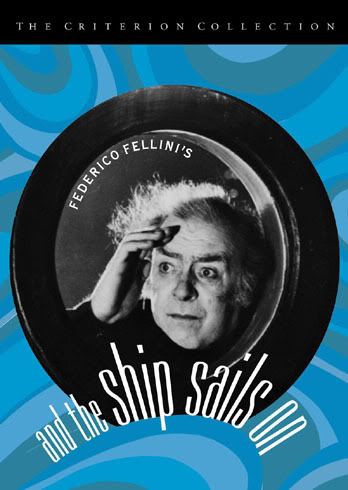
And The Ship Sails On (1983)
Country: Italy
I'm feeling kind of nostalgic these days. This is probably because, for the first time since I can remember, I'm not getting ready for the big trip back to school like nearly everyone else around me. So, it's somewhat fitting for me to next write about a film by Federico Fellini, who a) is a master of depicting memories and nostalgia on film, and b) I first discovered in my first year at U of T (via the wonderful 8 1/2, which kept pleasantly cropping up in various classes throughout my later years of study and is still one of my favorite films). And The Ship Sailed On is one of Il Maestro's later efforts, and you can tell that this film is echoing a style that has already been constructed and perfected through his previous masterpieces.
This film is very much exemplary of the kind of work Fellini produced in the later half of his career. While these films were filled with eye-popping visual compositions and massive amounts of imagination, they just didn't have the same sense of emotional involvement or intimacy that his earlier films did. As Satyajit Ray once explained (paraphrased here), this late-career Fellini was still very admirable and inspirational, but only as a cinematic technician.
As with other late Fellini films, there are no real main characters to really grow attatched to. Instead, the film follows a strange (and, I have to admit, often downright creepy) assortment of passengers who are gathered on an ocean liner to scatter the ashes of Edmea Tetua, a famous opera singer, off the coast of the island Erino. They mainly consist of other prominent opera singers, pretentious intellectual types and the plump, medal-laden Grand Duke of Herzog and his entourage. As in Fellini's Amarcord, the audience is given a polite, well-meaning guide who frequently takes time to contribute his commentary on whatever is happening at the given moment. All of these curious people are amusing to behold; just don't expect to be given an intimate emotional profile or strong connection to any of them during the film. To many viewers, they will only appear as a bunch of goofy kooks and only remain as such until the final title card. Those seeking more well-written and sympathetic main characters will be more than rewarded by some of Fellini's earlier efforts such as La Strada, Nights of Cabiria and 8 1/2.

Of course, the artificial nature of the film is made obvious by the fact that Fellini shot it almost entirely on the soundstages of Cinecitta studios, as was also his regular practice throughout the later stages of his career. There's definitely a certain artistry to the ways in which Fellini would replicate settings and special effects in this way; everything has a unique, theatrical look to it. The sea is a rolling, twinkling blue canopy suspending immobile lifeboats. A warship that appears late in the film is a massive iron fortress with stiff black clouds perpetually surrounding its smokestacks (both it and the ocean liner are obviously models). The film's artifice is even directly revealed at the end of the film in a segment that shows us the machinery and crew within the Cinecitta studio behind all the fantasy. It's a move not too dissimilar from a magician suddenly revealing the secret of his famous optical illusion, but with Fellini, the magic doesn't come from being fooled, but instead from the effort and craftsmanship that went into his tricks.
And The Ship Sailed On, again, like Amarcord, has a fairly straightforward, episodic structure to it. Along with the ocean liner guests, the viewer is treated to a variety of spectacles along the voyage, including:
- A concert given entirely via water glasses.
- A singing contest between the various sopranos within the ship's furnace, showcasing not only the range of their voices, but also the cavernous insides of their mouths.
- A giant rhinoceros who is diagnosed as suffering from lovesickness.
- The surprise arrival of a group of Serbian refugees who occupy part of the ship's deck and give a musical performance of their own (and eventually attract the attention of the mentioned battleship).
All of these episodes and more show that Fellini may have gradually changed his filmmaking methods as his career progressed, but his imagination lost none of its wild inventiveness.
Throughout the film, the ship's guests constantly tell stories and anecdotes, very much giving the impression that their lives, albeit fictional, extend so much more beyond what Fellini gives us, which is a small, fleeting glimpse; a mere portion of the whole. Perhaps this is why his later films have been seen as more distant and unapproachable - in his earlier films, his main characters had well-written, fully-realized arcs that consisted of highly significant (if not the most significant) events in their lives. The sightseers of Amarcord and And The Ship Sailed On, on the other hand, go from episode to episode existing only as such, merely along for the ride with the rest of the audience, undaunted by emotional crises and moral dilemmas. In terms of film viewing, this method of storytelling is an acquired taste (when I first saw it, I didn't really think much of the carnivalesque Amarcord, but I'm gradually warming up to it bit by bit), but those who try hard enough or let themselves should certainly be able to take their share of pleasure away from it.
Though it's not one of Il Maestro's greatest films, And The Ship Sailed On is still a highly enjoyable ride through the weird and wacky world of his mind, and certainly worth checking out at least for long-time Fellini fans. More casual viewers can take their chances, but would most likely benefit from warming up to some of his other films first; La Strada, La Dolce Vita or 8 1/2 would all be good places to start.
P.S. Something should probably be said about the music in this film. Sadly, Fellini was unable to work with his regular collaborator, the legendary Nino Rota, due to his death a few years previous. However, he made do with a smattering of well-known classical music, including Strauss' Blue "2001" Danube Waltz and a personal favorite of mine, Claude Debussy's Claire de Lune. Though it's a sort of "greatest hits" collection, it is nonetheless used fairly well throughout the film.